The New Era of Energy Autonomy in 2026
Commercial energy storage is no longer just a backup solution for power outages. In 2026, Battery Energy Storage Systems (BESS) have evolved into active revenue-generating infrastructure that helps businesses reduce operational costs, stabilize energy supply, and create new income streams.
Rising electricity volatility, stricter carbon reduction policies, and the expansion of renewable energy adoption are pushing businesses toward energy independence. Across Europe, North America, Southeast Asia, and industrial regions in China, companies are now deploying commercial battery storage systems not only for resilience but also for financial optimization.
The introduction of stricter carbon taxation mechanisms — including updates to the EU Carbon Border Adjustment Mechanism (CBAM) — has accelerated the shift toward low-carbon energy infrastructure. Businesses with high electricity consumption are under pressure to reduce peak demand, optimize renewable utilization, and lower carbon intensity.
As a result, modern commercial energy storage systems are becoming one of the most strategic infrastructure investments for:
- Manufacturing facilities
- Logistics warehouses
- Data centers
- EV charging stations
- Commercial buildings
- Retail chains
- Industrial parks
- Solar-integrated facilities
At the center of this transformation is the combination of advanced lithium battery technology, AI-powered Energy Management Systems (EMS), and modular scalable architecture.
Understanding Commercial Energy Storage ROI in 2026
Return on Investment (ROI) for commercial battery storage is determined by multiple financial and technical factors.
The core ROI equation includes:
- Initial capital expenditure (CAPEX)
- Long-term operational expenditure (OPEX)
- Utility bill savings
- Revenue from grid participation
- Renewable energy optimization
- Tax incentives and carbon credits
In 2026, improved battery cycle life, smarter EMS software, and declining battery costs have significantly shortened payback periods.
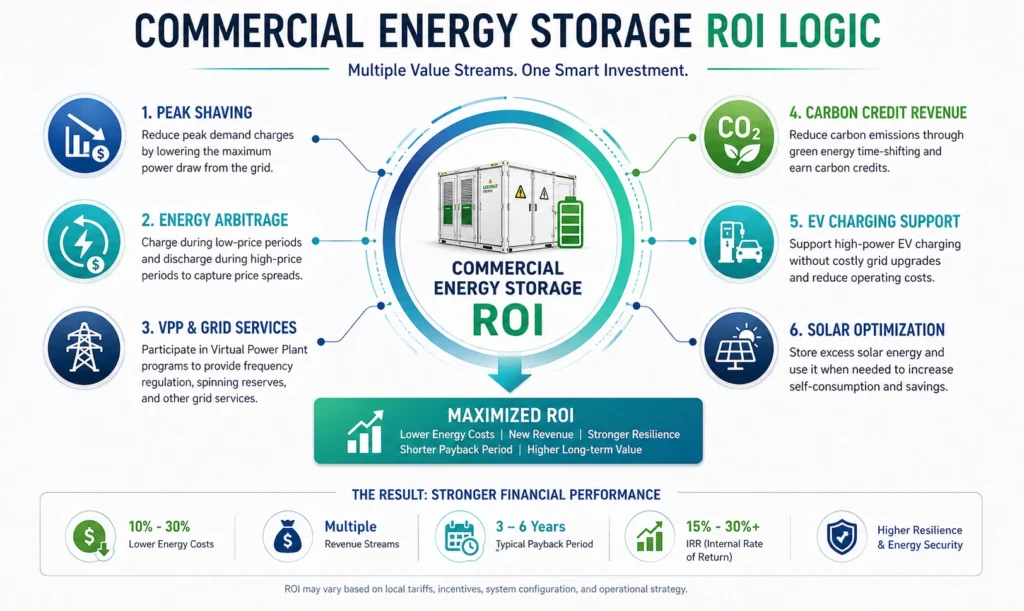
For many commercial and industrial facilities, the average payback period has dropped to between 3 and 6 years.
The Financial Foundation: CAPEX and OPEX in 2026
1. Capital Expenditure (CAPEX)
Hardware Evolution: LFP Batteries and Sodium-Ion Growth
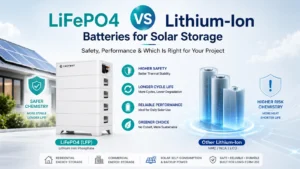
Lithium Iron Phosphate (LFP) batteries continue to dominate the commercial energy storage market due to their superior thermal stability, long cycle life, and lower fire risk.
Modern 2026-grade LFP battery systems now commonly exceed:
- 10,000 charge-discharge cycles
- 90%+ round-trip efficiency
- 15-year design lifespan
At the same time, Sodium-ion battery technology has entered the commercial and industrial (C&I) storage market for facilities where energy density is less critical.
Compared with conventional lithium-ion systems, Sodium-ion storage can reduce upfront CAPEX by approximately 20–30%, making battery storage more accessible for small and medium-sized businesses.
EPC and Grid Interconnection Costs
Beyond battery hardware, businesses must consider additional deployment expenses:
- Engineering and system design
- Procurement and logistics
- Construction and installation
- Fire protection systems
- Utility interconnection fees
- Local permitting and compliance
The complexity of grid connection requirements varies by country and utility provider.
For example:
- Germany prioritizes grid-responsive ESS integration
- The United States offers regional incentives for VPP-compatible systems
- Southeast Asia focuses on industrial load balancing and diesel displacement
AI-Driven EMS Integration
In 2026, AI-driven Energy Management Systems are no longer optional.
Modern EMS platforms now use predictive algorithms to:
- Forecast electricity prices
- Predict weather-driven solar generation
- Analyze facility load patterns
- Optimize charging and discharging schedules
- Enable automated demand response participation
Generative AI-based predictive dispatch systems can improve annual ROI by an estimated 12% compared to static scheduling strategies commonly used in earlier-generation storage deployments.
2. Operational Expenditure (OPEX)
Remote Diagnostics vs. On-Site Maintenance
Modern commercial ESS systems increasingly rely on remote diagnostics.
Cloud-connected monitoring platforms can identify:
- Cell imbalance
- Thermal anomalies
- Voltage inconsistencies
- PCS performance deviations
- Cooling system irregularities
This reduces expensive on-site maintenance visits and minimizes downtime.
Round-Trip Efficiency Degradation
Battery efficiency naturally declines over time.
When evaluating ROI, businesses should model long-term performance degradation over a 10–15 year operational period.
High-quality liquid-cooled LFP systems typically maintain stronger long-term efficiency compared with lower-cost air-cooled alternatives.
Insurance and Safety Costs
Insurance premiums are increasingly influenced by:
- Fire suppression technology
- UL 9540 certification
- Thermal runaway protection
- System monitoring capabilities
- Installation environment
Commercial ESS systems equipped with advanced fire suppression and intelligent thermal management generally qualify for lower insurance risk profiles.
The Value Stacking Revenue Model: How Commercial ESS Generates Profit
One of the biggest changes in 2026 is the rise of “value stacking.”
Instead of relying on a single savings mechanism, businesses now combine multiple revenue streams simultaneously.
1. Traditional Savings Mechanisms
Peak Shaving and Demand Charge Management
Many utilities charge commercial customers based on their highest peak demand during a billing cycle.
Battery storage systems can discharge during high-demand periods to reduce peak grid consumption.
This lowers:
- Demand charges
- Capacity fees
- Grid stress exposure
For industrial facilities with unstable peak loads, demand charge reduction often becomes the largest contributor to ROI.
Energy Arbitrage
In regions with dynamic electricity pricing, this creates substantial annual savings.
Energy arbitrage involves charging batteries during low-price periods and discharging during expensive peak hours.
AI-powered EMS platforms now optimize arbitrage automatically by predicting:
- Real-time market prices
- Renewable generation availability
- Facility demand patterns
2. Advanced Revenue Streams in 2026
Virtual Power Plant (VPP) Participation
Commercial battery systems can now participate in Virtual Power Plant networks.
A VPP aggregates distributed energy assets and sells grid support services such as:
- Frequency regulation
- Spinning reserve capacity
- Demand response
- Voltage support
This transforms commercial ESS from a passive cost-saving tool into an active revenue-generating energy asset.
EV Charging Infrastructure Support
Ultra-fast EV charging stations place significant strain on local transformers and utility infrastructure.
Battery storage systems help charging operators:
- Avoid expensive transformer upgrades
- Stabilize charging power
- Reduce demand spikes
- Improve charging reliability
As EV adoption accelerates globally, integrating ESS with EV charging infrastructure has become a major commercial opportunity.
Carbon Credit Monetization
Many governments and carbon markets now reward businesses for reducing carbon emissions.
By storing renewable electricity and reducing fossil-fuel-based peak generation, commercial battery systems can generate measurable carbon reduction benefits.
These reductions may be monetized through:
- Carbon credit trading
- Green certificates
- ESG-linked financing incentives
- Sustainability reporting advantages
Discover how much your business can save with intelligent battery energy storage.
Get a customized ROI analysis based on your facility load profile, utility tariff, and energy goals.
Start Your Energy Storage Journey Today
From residential to commercial-scale energy storage solutions, we help you reduce energy costs, improve efficiency, and achieve energy independence with scalable systems from 5kWh to 1.93MWh.
Technical Factors That Directly Impact ROI
Cycle Life and Depth of Discharge (DoD)
The shift toward high-cycle-life LFP batteries has fundamentally changed energy storage economics.
Modern commercial ESS systems can now support:
- Deep discharge operations
- Daily cycling applications
- Long-duration storage
- High-frequency grid services
This increases total lifetime energy throughput and improves long-term ROI.
C-Rate Optimization
Choosing the correct power-to-energy ratio is critical.
High-power systems (1C) are ideal for:
- Fast-response grid services
- EV charging support
- Rapid peak shaving
High-energy systems (0.5C) are better suited for:
- Solar energy shifting
- Long-duration backup
- Renewable optimization
Proper load profile analysis is essential before selecting system architecture.
Liquid Cooling vs. Air Cooling
Thermal management significantly affects battery lifespan.
Liquid-cooled ESS systems offer:
- Better temperature uniformity
- Lower degradation rates
- Higher operating efficiency
- Improved safety
- Longer system lifespan
Although initial costs are higher, liquid cooling often delivers stronger long-term ROI for commercial and industrial deployments.
Real-World Commercial Energy Storage Case Studies in 2026
Case Study A: Net-Zero Manufacturing Plant in China and Germany
Project Overview
A manufacturing facility deployed a:
- 2MW / 4MWh battery storage system
- Rooftop solar integration
- AI-based EMS platform
Business Goals
- Reduce peak demand charges
- Increase solar self-consumption
- Lower carbon emissions
- Improve energy resilience
Results
Due to favorable 2026 energy policies and double-charging optimization programs, the project achieved:
- Payback period: 3.8 years
- Significant reduction in grid dependency
- Improved renewable utilization
- Lower carbon compliance costs
Case Study B: Urban Data Center in the United States
Project Overview
A major data center operator replaced diesel generators with a commercial BESS solution.
The system provided:
- UPS backup functionality
- Grid support participation
- Demand response capability
- Renewable integration support
Results
The project achieved:
- 25% IRR (Internal Rate of Return)
- Lower maintenance costs than diesel systems
- Eligibility for Investment Tax Credits (ITC)
- Additional VPP revenue participation
This demonstrates how energy storage is becoming essential infrastructure for mission-critical facilities.
How EASYWAY Energy Supports Commercial ESS ROI Optimization
As businesses demand more scalable and intelligent storage infrastructure, modular ESS architecture has become a key differentiator.
Scalable Commercial Energy Storage Architecture
EASYWAY Energy commercial battery storage solutions are designed for flexible deployment scenarios ranging from small commercial facilities to large-scale industrial energy systems.
Key capabilities include:
- Starting capacity from 5kWh
- Expandable architecture up to 1.93MWh
- Modular plug-and-play design
- High-cycle-life LFP battery technology
- Smart EMS integration
- Remote monitoring and diagnostics
- Industrial-grade safety systems
This scalability allows businesses to deploy storage incrementally based on actual operational needs and future expansion plans.
Designed for Multiple Commercial Applications
EASYWAY Energy systems support a wide range of commercial applications:
Manufacturing Facilities
- Peak shaving
- Solar self-consumption
- Backup power
- Carbon reduction
EV Charging Stations
- Demand management
- Transformer load reduction
- Fast charging stabilization
Commercial Buildings
- Energy cost optimization
- Backup resilience
- Smart energy scheduling
Data Centers
- UPS replacement support
- Grid participation
- High-reliability backup systems
Renewable Energy Integration
- Solar + storage optimization
- Time-shifting renewable generation
- Curtailment reduction
Risk Mitigation and Strategic Planning for Commercial ESS Investments
Regulatory Compliance in 2026
Commercial ESS systems must comply with evolving international safety standards.
Key certifications and standards include:
- UL 9540
- NFPA 855
- IEC battery standards
- Local utility interconnection codes
Working with experienced ESS manufacturers helps reduce permitting delays and compliance risks.
Future-Proofing Through Modular Design
Battery technology continues to evolve rapidly.
Modular architecture reduces technology obsolescence risks because businesses can:
- Expand capacity gradually
- Upgrade battery modules independently
- Integrate future EMS improvements
- Adapt to changing utility programs
This flexibility is becoming increasingly important for long-term infrastructure planning.
Flexible Financing Models
Commercial energy storage financing has matured significantly.
Common financing structures now include:
- Lease-to-own agreements
- Power Purchase Agreements (PPA)
- Energy-Storage-as-a-Service (ESaaS)
- Green bonds
- ESG-linked financing
In late 2025, a global retailer financed a 500-store ESS rollout using green bonds with interest rates 2% lower than conventional corporate debt.
This accelerated ROI by approximately 14 months.
The Future of Commercial Energy Storage Beyond 2026
Several trends are expected to shape the next phase of commercial ESS adoption.
AI-Powered Autonomous Energy Management
Energy systems are rapidly becoming autonomous.
Future EMS platforms will increasingly integrate:
- AI forecasting
- Grid market prediction
- Automated dispatch optimization
- Real-time carbon optimization
- Predictive maintenance
This will further improve operational efficiency and ROI.
Long-Duration Storage Expansion
Sodium-ion batteries and hybrid storage technologies are expected to expand long-duration commercial applications.
This is especially important for:
- Industrial microgrids
- Renewable-heavy facilities
- Remote commercial sites
- Utility-scale distributed storage
Deeper Integration with Renewable Energy
Commercial battery storage is becoming the foundation of distributed renewable infrastructure.
Businesses adopting solar + storage systems today are positioning themselves for:
- Lower long-term energy costs
- Improved energy security
- Reduced carbon exposure
- Stronger ESG positioning
Final Verdict: Why Commercial Battery Storage Is a Low-Risk, High-Yield Investment
In 2026, commercial battery energy storage systems are no longer experimental technology.
They have become mature financial infrastructure capable of delivering:
- Predictable operational savings
- New recurring revenue streams
- Improved energy resilience
- Carbon reduction benefits
- Long-term business competitiveness
The combination of:
- Falling battery costs
- High-cycle-life LFP technology
- AI-driven EMS optimization
- VPP monetization
- Renewable energy integration
has fundamentally transformed the economics of commercial energy storage.
For modern enterprises, investing in BESS is increasingly viewed not as an energy expense, but as a strategic financial asset.
How to Evaluate Your Commercial ESS Opportunity
Before deployment, businesses should:
- Conduct a 12-month load profile analysis
- Evaluate utility tariff structures for 2026–2027
- Analyze peak demand behavior
- Assess renewable energy integration opportunities
- Review local incentives and carbon programs
- Select scalable modular ESS architecture
- Partner with experienced commercial energy storage providers
About EASYWAY Energy
EASYWAY Energy provides scalable commercial and industrial energy storage solutions designed for modern energy optimization.
With modular expansion from 5kWh to 1.93MWh, intelligent EMS integration, and high-safety LFP battery technology, EASYWAY Energy helps businesses:
- Reduce electricity costs
- Improve energy independence
- Support renewable integration
- Optimize EV charging infrastructure
- Enhance operational resilience
Whether for factories, data centers, commercial buildings, or EV charging networks, EASYWAY Energy delivers flexible ESS solutions built for the evolving energy landscape of 2026 and beyond.