Understanding kW vs kWh in battery storage helps buyers answer two different questions: what can the battery system power at one time, and how long can it keep those loads running?
Kilowatts, written as kW, measure power. Kilowatt-hours, written as kWh, measure energy. A battery may store enough energy for several hours but still lack the power output required to start an air conditioner, pump or commercial machine. The opposite is also possible: a high-power system may support large loads but run out of stored energy quickly.
This guide explains both ratings, provides practical runtime examples and shows installers, distributors and project buyers how to compare battery specifications correctly.
Key Takeaways
- kW measures the rate at which a battery, inverter or electrical load delivers or consumes power.
- kWh measures the amount of electrical energy stored or consumed over time.
- Battery kW determines how much equipment the system can support simultaneously.
- Battery kWh helps determine how long the connected loads can operate.
- A 10kW inverter does not automatically require a 10kWh battery.
- Nominal battery capacity is not always equal to the energy available to the loads.
- Buyers must compare continuous power, peak power, usable energy, battery voltage and inverter compatibility together.
What Is the Difference Between kW and kWh in Battery Storage?
The difference is simple: kW measures power, while kWh measures energy.
The watt is a unit of power, which describes the rate at which energy is transferred. One kilowatt equals 1,000 watts. A kilowatt-hour is a unit of electrical energy equal to using one kilowatt of power for one hour. (NIST)
| Measurement | Full name | What it tells the buyer | Simple question |
|---|---|---|---|
| kW | Kilowatt | How much power the system can deliver at one time | What can the battery run? |
| kWh | Kilowatt-hour | How much electrical energy the battery stores | How long can it run? |
| kWp | Kilowatt-peak | The rated peak capacity of a solar PV array | How large is the solar array? |
| A | Ampere | The electrical current flowing through the system | How much current must the battery and cables handle? |
| V | Volt | The electrical potential of the battery system | Is the battery compatible with the inverter? |
The U.S. Department of Energy uses the same distinction for energy storage: energy capacity is the total amount of energy that can be stored, normally measured in kWh or MWh, while power capacity is the rate at which that energy can be released, normally measured in kW or MW. (The Department of Energy’s Energy.gov)
What Does kW Mean on a Battery Specification?
On a battery specification, kW describes how quickly the system can charge, discharge or supply connected loads.
However, several different kW ratings may appear on one datasheet. Buyers should identify exactly what each number represents.
Continuous Discharge Power
Continuous discharge power is the output that the battery can sustain under the specified operating conditions.
A battery rated for 5kW continuous discharge may support loads totalling approximately 5kW, provided the inverter, battery management system and installation are designed for that output.
It does not mean every 5kW load will work automatically. Motor-driven equipment may require a much higher startup current.
Peak or Surge Power
Peak power is the higher output a battery or inverter can support for a short period.
This rating matters for equipment such as:
- Air conditioners
- Heat pumps
- Refrigerators and freezers
- Water pumps
- Compressors
- Electric motors
- Workshop equipment
A peak rating should always include a duration. “10kW peak” is incomplete unless the buyer also knows whether that output is available for a few seconds, one minute or longer.
Charge Power
Charge power describes how quickly the battery can accept energy from solar panels, the grid or another source.
A 10kWh battery charged at 2kW will take considerably longer to recharge than the same battery charged at 5kW. Actual charging time also depends on state of charge, battery temperature, charge limits and conversion losses.
Battery Power vs Inverter Power
Battery discharge power and inverter AC output are related but are not always identical.
A system may include:
- A battery with a maximum DC discharge rating
- An inverter with a continuous AC output rating
- A different short-term inverter surge rating
- A whole-system output limit set by software or grid requirements
Buyers should also confirm whether the stated kW figure is measured on the DC battery side or the AC output side. Comparing a DC rating from one product with an AC rating from another can produce a misleading result.
What Does kWh Mean on a Battery Specification?
The kWh rating describes the battery’s energy capacity.
For example:
- A 5kWh battery stores approximately half as much nominal energy as a 10kWh battery.
- A 20kWh battery stores approximately twice as much nominal energy as a 10kWh battery.
- A 2.3kWh battery stores 2.3 kilowatt-hours of nominal energy.
However, the largest kWh number on a datasheet may not equal the energy available to the connected appliances.
Nominal Capacity
Nominal capacity is the theoretical or nameplate energy stored by the battery under specified conditions.
For a battery module rated at 51.2V and 100Ah:
51.2V × 100Ah = 5,120Wh = 5.12kWh
This calculation identifies nominal energy. It does not determine maximum output power.
Usable Capacity
Usable capacity is the portion of nominal energy that the system allows the user to access.
Usable energy may be lower because of:
- Depth-of-discharge limits
- Backup reserve settings
- Battery management system protection
- Inverter conversion losses
- Low- or high-temperature restrictions
- Long-term battery degradation
A buyer comparing two 10kWh batteries should therefore check whether each specification refers to nominal energy or usable energy.
State of Charge and Backup Reserve
State of charge indicates how much energy remains in the battery.
A system configured to maintain a 20% backup reserve will not normally use that reserved energy for daily solar self-consumption. The battery may be described as 10kWh, but less energy will be available for routine operation.
The reserve is not necessarily wasted capacity. It may be intentionally retained for grid outages or to protect the battery from deep discharge.
How Do You Calculate Battery Energy and Runtime?
The basic relationship is:
Energy in kWh = Power in kW × Time in hours
This formula means that:
- A 1kW load running for 5 hours consumes 5kWh.
- A 2kW load running for 5 hours consumes 10kWh.
- A 5kW load running for 2 hours consumes 10kWh.
- A 10kW load running for 1 hour consumes 10kWh.
Each example uses the same amount of energy, but the required power output is different.
Battery Runtime Formula
A simple ideal runtime estimate is:
Runtime in hours = Usable battery capacity in kWh ÷ Average load in kW
The calculation assumes a steady load and does not yet include conversion losses or operating restrictions.
How Long Will a 2.3kWh Battery Last?
The ideal runtime of a 2.3kWh battery depends on the connected load.
| Average load | Ideal runtime from 2.3kWh |
|---|---|
| 0.25kW | 9.2 hours |
| 0.5kW | 4.6 hours |
| 1kW | 2.3 hours |
| 2kW | 1.15 hours |
Real operating time will normally be shorter if 2.3kWh is the nominal rather than usable capacity. Inverter losses, reserve settings, temperature and changing appliance loads must also be considered.
A 2.3kWh battery may be useful for small essential loads, telecommunications equipment or short-duration backup. It is unlikely to provide long whole-home backup when heating, cooling or electric cooking loads are included.
What Does the kWh-to-kW Ratio Tell You?
The ratio between battery energy and battery power indicates the approximate duration available at rated power.
The formula is:
Full-power duration = Energy capacity in kWh ÷ Power rating in kW
Energy-to-power ratio is commonly used to describe storage duration. NREL describes the E/P ratio as battery energy divided by battery power and treats it as the storage duration in hours. (ATB)
| Battery configuration | Ideal duration at full rated power |
|---|---|
| 10kWh / 5kW | 2 hours |
| 20kWh / 5kW | 4 hours |
| 20kWh / 10kW | 2 hours |
| 40kWh / 10kW | 4 hours |
| 100kWh / 50kW | 2 hours |
These figures are simplified nameplate ratios. Actual usable duration may be lower after accounting for usable capacity, system efficiency and operating limits.
This ratio helps distinguish two broad system types:
- A high-power battery can support larger loads but may provide relatively short runtime.
- A high-energy battery stores more kWh relative to its power output and can support moderate loads for longer.
Neither design is automatically better. The correct ratio depends on the application.
Is a 10kW Battery the Same as a 10kWh Battery?
No. A 10kW rating and a 10kWh rating describe different properties.
A system rated at 10kW can deliver power at a rate of up to 10 kilowatts under its specified conditions. A battery rated at 10kWh stores 10 kilowatt-hours of nominal or usable energy, depending on the datasheet.
A 10kWh battery operating at a constant 10kW output has an ideal nameplate duration of only one hour. At a 2kW average load, the same energy capacity could theoretically last five hours.
The 10kW inverter and 10kWh battery do not need to match numerically. The correct pairing depends on:
- Simultaneous load demand
- Required backup time
- Battery discharge current
- Battery voltage
- Inverter efficiency
- Startup surge
- Solar recharging schedule
- Permitted battery configurations
How Does kW vs kWh Work in Solar Systems?
In a solar system, kW normally describes the peak power rating of the photovoltaic array, while kWh describes the energy generated over a period of time.
A 5kW solar array does not produce exactly 5kWh per day. Its instantaneous output changes with sunlight, time of day, season, temperature, shading, dirt and system losses. The Department of Energy notes that solar production is affected by season, clouds, dust, haze, snow, rain and physical obstructions. (The Department of Energy’s Energy.gov)
How Many kWh Does a Solar Panel Produce?
There is no universal answer. The correct unit for energy production is kWh, not “kW hours.”
A simplified estimate is:
Solar energy produced = Array power in kW × Equivalent full-output hours
For illustration:
| Solar array | Equivalent full-output time | Energy before additional system adjustments |
|---|---|---|
| 5kW | 2 hours | 10kWh |
| 5kW | 4 hours | 20kWh |
| 5kW | 6 hours | 30kWh |
These examples are not production forecasts. Real energy yield requires location-specific solar resource data, roof orientation, tilt, shading and system-loss assumptions.
This distinction also explains why a 5kW solar array can be paired with a battery larger or smaller than 5kWh. The array rating and the battery capacity measure different quantities.
How Should Buyers Size kW and kWh Together?
Battery sizing should begin with the load profile, not with a popular product size.
Step 1: Calculate Simultaneous Power Demand
List the appliances or equipment that may run at the same time.
Add their running power to estimate the required continuous kW. Then identify motors, pumps, compressors or HVAC equipment that may create a startup surge.
For residential backup, decide whether the system must support:
- Only essential circuits
- Most household circuits
- Whole-home loads
- Large heating or cooling equipment
- EV charging
For commercial projects, review measured interval demand rather than relying only on monthly energy bills.
Step 2: Define the Required Runtime
Decide how many hours the battery must support the loads.
The answer may differ by application:
- Evening solar self-consumption
- Short outage backup
- Overnight operation
- Peak shaving
- Off-grid autonomy
- Critical commercial operations
Multiply the expected average load by the required runtime to estimate delivered energy.
Step 3: Adjust for Usable Capacity and Losses
Suppose the project needs to supply an average 2kW load for four hours:
2kW × 4 hours = 8kWh delivered energy
If a preliminary calculation assumes 90% usable battery capacity and 90% conversion efficiency:
Required nominal capacity = 8kWh ÷ (0.90 × 0.90) = approximately 9.9kWh
The 90% assumptions are illustrative, not universal product values. Buyers should replace them with the actual usable-capacity and efficiency data for the proposed system.
Step 4: Confirm Battery Discharge Capability
A battery bank may contain enough kWh but still be unable to deliver the required kW.
Check:
- Continuous battery discharge current
- Continuous discharge power
- Peak discharge power and duration
- Battery management system limits
- Number of modules required
- Inverter-supported configurations
Step 5: Check Recharging Capability
A battery that lasts through the night must also be able to recharge from the available solar array or grid connection.
Consider:
- Solar energy available after household daytime consumption
- Maximum battery charge power
- Seasonal solar production
- Grid charging limits
- Time-of-use charging windows
- Expected next-day energy requirement
How Should Buyers Read a Battery Specification Sheet?
The most useful battery comparison considers the following values together.
| Specification | What the buyer should confirm |
|---|---|
| Nominal energy | Total nameplate capacity in kWh |
| Usable energy | Energy available within permitted operating limits |
| Continuous discharge power | Sustained output in kW |
| Peak discharge power | Short-duration output and its permitted duration |
| Charge power | Maximum rate at which the battery can recharge |
| Battery voltage | Compatibility with the inverter architecture |
| Maximum current | Cable, protection and BMS requirements |
| Depth of discharge | Portion of capacity intended for regular use |
| Expansion limit | Maximum modules, clusters or parallel systems |
| Inverter compatibility | Supported voltage and communication protocol |
| Installation environment | Indoor/outdoor rating and temperature range |
| Warranty terms | Years, cycles, throughput and remaining-capacity conditions |
The EASYWAY battery and energy storage product range includes residential products identified by energy capacities such as 5kWh, 10kWh and 16kWh, as well as commercial systems whose names show both kWh and kW. This naming difference reflects the way residential modules are commonly compared by stored energy, while integrated commercial systems need an explicit energy and power rating. (Leading Lithium Battery Manufacturer)
The project examples make the distinction more concrete. EASYWAY’s battery project references include a 215kWh/100kW cabinet and a 261kWh/125kW cabinet. In each case, kWh describes stored energy and kW describes rated output power. Their ideal nameplate durations at rated power are approximately 2.15 and 2.09 hours respectively, before system losses and operating limits are considered. (Leading Lithium Battery Manufacturer)
Buyers should not assume that every project requires the same two-hour ratio. A peak-shaving system, long-duration backup system and residential self-consumption battery can require very different power-to-energy ratios.
Not Sure How Much kW and kWh Your Project Needs?
Share your load profile, required backup time, inverter model and target capacity. EASYWAY can help you compare battery power, usable energy and compatible system configurations for your project.
For installers, distributors and energy storage projects.
Does Battery Chemistry Change kW and kWh?
Battery chemistry does not change the meaning of kW or kWh. However, it can affect how much of the nameplate energy is usable, how much power the battery can deliver, how it performs at different temperatures and how the system ages.
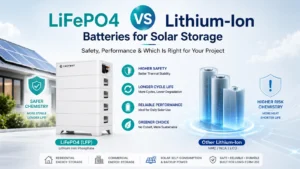
Lithium iron phosphate (LiFePO4 or LFP) is widely used in stationary solar storage. Buyers comparing LFP with other lithium-ion chemistries can review this guide to LiFePO4 vs lithium-ion batteries for solar storage.
Chemistry should still be evaluated alongside:
- Cell quality
- Battery management system design
- Charge and discharge limits
- Temperature range
- Warranty throughput
- Inverter compatibility
- Installation requirements
A chemistry label alone does not reveal the system’s usable kWh or continuous kW.
Common kW and kWh Buying Mistakes
Buying Based Only on kWh
A large kWh battery may provide long runtime but insufficient output for high-demand equipment.
Buying Based Only on Inverter kW
A powerful inverter connected to a small battery may support large loads only briefly before the stored energy is depleted.
Matching kW and kWh One to One
A 10kW inverter does not automatically require a 10kWh battery. The correct ratio depends on the load profile and required duration.
Ignoring Nominal vs Usable Capacity
Two batteries labelled 10kWh may provide different usable energy because of reserve settings, depth-of-discharge limits and system design.
Ignoring Startup Power
Average energy consumption does not reveal the short power surge required by motors, compressors and pumps.
Confusing Solar Array Size With Daily Production
A 5kW solar array has a peak power rating. Its daily energy generation is measured in kWh and changes with location and operating conditions.
Assuming Additional Modules Always Increase Power Equally
Adding battery modules usually increases energy capacity, but the increase in power output depends on BMS limits, wiring architecture, inverter limits and the manufacturer-supported configuration.
kW vs kWh Battery Selection Matrix
| Project goal | kW priority | kWh priority | Main design question |
|---|---|---|---|
| Essential home backup | Moderate | Moderate | Can critical loads start and run for the required time? |
| Whole-home backup | High | High | Can the system support simultaneous large loads for several hours? |
| Solar self-consumption | Moderate | High | Can the battery store and supply evening energy use? |
| Off-grid home | High | Very high | Can the system cover peak loads and low-solar periods? |
| Commercial peak shaving | High | Depends on peak duration | How much demand must be reduced and for how long? |
| Short power-quality support | Very high | Low | Can the battery respond quickly to short events? |
| Long-duration business backup | High | Very high | How long must critical operations continue? |
Installers and distributors selecting a system for a specific inverter, load profile or market can share the required kW, kWh, voltage and application with EASYWAY’s project team for configuration matching.
Frequently Asked Questions
What Does kW Mean on a Battery?
kW means kilowatt and measures power. On a battery specification, it may describe continuous discharge power, peak output or charge power. Buyers should verify which rating is being shown, whether it is measured on the AC or DC side and how long any peak output can be sustained.
What Does kWh Mean on a Battery?
kWh means kilowatt-hour and measures stored electrical energy. A 10kWh battery contains approximately twice the nominal energy of a 5kWh battery. Actual energy available to loads may be lower because of reserve settings, depth-of-discharge limits, temperature restrictions and conversion losses.
Is a 10kW Battery the Same as a 10kWh Battery?
No. A 10kW rating describes the rate of power delivery, while a 10kWh rating describes stored energy. A system could have 10kW output and 20kWh capacity, giving an ideal two-hour duration at full output, or another power-to-energy combination.
How Long Will a 2.3kWh Battery Last?
A 2.3kWh battery has an ideal runtime of 2.3 hours at a constant 1kW load or 4.6 hours at a 0.5kW load. Actual runtime will be lower if the rating is nominal capacity or if the system maintains reserve energy and experiences conversion losses.
How Many kWh Does a Solar Panel Produce?
There is no universal figure. Solar panel and array power is rated in watts or kW, while energy production is measured in kWh. Daily output depends on array size, location, sunlight, season, orientation, shading, temperature and system losses.
Does a Higher-kWh Battery Provide More Power?
Not necessarily. Higher kWh means more stored energy, but maximum power depends on battery discharge limits, BMS current, module configuration and inverter capability. A larger-energy battery can still have a relatively low continuous kW rating.
How Do I Calculate the Battery Size I Need?
First calculate the combined kW of the loads that must operate simultaneously. Then multiply the average load by the required runtime to estimate kWh. Finally, adjust for usable capacity, inverter losses, startup surges, battery temperature, reserve settings and future expansion.
Do More Battery Modules Increase Both kW and kWh?
Additional modules normally increase kWh, but the effect on kW is system-specific. Some configurations increase both energy and discharge capability, while others remain limited by the master BMS, inverter or electrical architecture. Use only manufacturer-supported combinations.
Conclusion
kW and kWh are related, but they are not interchangeable.
kW tells the buyer how much power a battery system can deliver at one time. It determines whether the system can support simultaneous loads and short startup surges.
kWh tells the buyer how much energy the battery stores. It helps determine how long the loads can operate before the battery needs to recharge.
A correctly sized battery energy storage system must satisfy both requirements. Buyers should:
- Calculate simultaneous and startup power in kW.
- Define the required operating time.
- Calculate the required energy in kWh.
- Distinguish nominal capacity from usable capacity.
- Check continuous and peak discharge ratings.
- Confirm battery voltage and inverter compatibility.
- Evaluate solar or grid recharging capability.
- Compare supported expansion configurations.
The largest kW or kWh number is not automatically the best choice. The correct battery is the system whose power, energy, voltage, inverter and operating limits match the real application.