A hybrid inverter and a battery inverter can both connect energy storage to a home or commercial electrical system, but they perform different roles.
A hybrid inverter normally combines solar photovoltaic conversion, battery charging and battery discharging in one device. A battery inverter manages the battery but usually relies on a separate solar inverter to convert power from the photovoltaic array.
The correct choice depends on whether the project is new or existing, how the solar and battery systems will be coupled, which batteries are compatible, whether backup power is required and how easily the system may need to expand later.
Key Takeaways
- A hybrid inverter combines the functions of a solar PV inverter and a battery inverter in one device.
- A battery inverter manages battery charging and discharging but normally does not include a direct solar-panel input.
- Hybrid inverters are commonly used for new solar-plus-storage installations with DC-coupled batteries.
- Battery inverters are commonly used to add AC-coupled storage to an existing string-inverter or microinverter solar system.
- Neither “hybrid” nor “battery inverter” automatically guarantees backup power during a grid outage.
- Hybrid systems can reduce the number of conversion stages when solar energy charges a DC-connected battery.
- Battery compatibility, voltage, communication protocol, power rating, phase configuration and local grid approval matter more than the product label alone.
What Is a Hybrid Solar Inverter?
A hybrid solar inverter is a power conversion device that combines a solar inverter and a battery inverter in one unit.
Solar photovoltaic panels produce direct current, or DC, electricity. Homes, businesses and public electricity grids normally use alternating current, or AC. A solar inverter converts the DC electricity generated by the panels into usable AC electricity. A bidirectional battery converter must also convert energy in both directions: DC battery energy becomes AC during discharge, while AC or solar energy is converted into the form required to charge the battery. (The Department of Energy’s Energy.gov)
A typical hybrid inverter may include:
- One or more maximum power point tracking inputs for solar strings
- A battery connection port
- Bidirectional battery charging and discharging
- Grid connection and monitoring
- Household load measurement
- Export limitation
- Time-of-use charging controls
- A backup or essential-load output on supported models
Most residential hybrid PV inverters connect both the solar array and battery on the DC side of the system. The inverter then coordinates power flow between the panels, battery, household loads and grid.
How Does a Hybrid Inverter Manage Solar Power?
When solar generation exceeds the building’s immediate consumption, a hybrid inverter can direct part of the available DC energy into the battery. When solar production falls below demand, it can convert stored battery energy into AC electricity for the loads.
Depending on the system design and settings, the inverter may prioritise:
- Household or business loads
- Battery charging
- Grid export
- Backup reserve
- Grid charging during selected tariff periods
The exact priority sequence is controlled by the inverter’s operating modes, battery limits and local grid requirements. Buyers should not assume that every hybrid inverter supports every power-flow option.
What Is a Battery Inverter?
A battery inverter is a bidirectional power conversion device that charges a battery from an AC source and converts stored DC battery energy back into AC electricity.
Unlike a typical hybrid solar inverter, a battery inverter normally does not include direct solar PV string inputs or solar maximum power point tracking. It connects the battery to the AC electrical system while a separate string inverter or set of microinverters manages the solar panels.
A battery inverter can therefore be added to a building that already has:
- A grid-connected string inverter
- Solar panel microinverters
- Multiple existing solar inverters
- An AC generator
- No solar system, where the battery is charged from the grid
SMA describes a battery inverter as the device that converts DC energy stored in a battery into AC electricity and distinguishes it from a hybrid inverter, which performs both PV-inverter and battery-inverter functions. (SMA Solar)
Hybrid Inverter vs Battery Inverter at a Glance
| Comparison factor | Hybrid inverter | Battery inverter |
|---|---|---|
| Direct solar PV input | Usually included | Usually not included |
| Battery connection | Included | Included |
| Typical architecture | DC-coupled solar and battery | AC-coupled battery |
| Solar conversion | Managed by the same unit | Managed by a separate PV inverter |
| Best-known application | New solar-plus-battery system | Battery retrofit for existing solar |
| Number of main inverters | Usually one combined unit | Separate PV and battery inverters |
| Battery compatibility | Limited to supported batteries | Still model-specific, but AC-side integration may offer more system flexibility |
| Monitoring | Often integrated in one platform | May involve separate solar and battery platforms |
| Solar-to-battery conversion | May require fewer conversion stages | Solar AC is converted back to DC for storage |
| Component replacement | One device handles multiple functions | PV and battery conversion equipment can be replaced separately |
| Backup power | Model- and design-dependent | Model- and design-dependent |
| Future retrofit flexibility | Depends on battery ecosystem | Often useful for existing or mixed-inverter systems |
What Is the Difference Between DC-Coupled and AC-Coupled Storage?
The main technical difference between many hybrid-inverter and battery-inverter systems is where the battery connects to the solar installation.
DC-Coupled Storage With a Hybrid Inverter
In a DC-coupled system, the solar panels and battery connect on the DC side of a shared inverter architecture.
A simplified solar-to-battery power path is:
Solar DC → battery DC
When the energy is later used:
Battery DC → inverter → household AC
This architecture can reduce the number of conversion stages when excess solar generation charges the battery. NREL describes one PV-battery hybrid architecture as using a shared bidirectional inverter for both PV and battery components. (NREL)
A DC-coupled hybrid system can be attractive when:
- Solar and storage are installed together
- Integrated monitoring is preferred
- The battery will be charged primarily from solar
- Equipment space is limited
- A compatible battery has already been selected
The main constraint is product interoperability. The inverter must support the battery voltage, current limits, battery management system communication and firmware.
AC-Coupled Storage With a Battery Inverter
In an AC-coupled system, the solar inverter and battery inverter connect to a shared AC electrical bus.
A simplified solar-to-battery path is:
Solar DC → PV inverter → AC → battery inverter → battery DC
When the energy is used:
Battery DC → battery inverter → household AC
The additional conversions can create more energy loss during solar charging than a well-matched DC-coupled design. However, AC coupling provides practical flexibility when the solar inverter is already installed.
AC-coupled storage is commonly considered for:
- Existing solar installations
- Microinverter systems
- Sites with multiple PV inverters
- Projects where the existing solar system should remain unchanged
- Battery systems that may need independent replacement or expansion
Official manufacturer guidance identifies AC-coupled storage as particularly useful when retrofitting batteries to existing PV installations. (SMA Solar)
Is a Hybrid Inverter Better Than a Battery Inverter?
Neither option is universally better. A hybrid inverter is often more suitable for a new solar-plus-storage project, while a battery inverter is often more practical for adding storage to an existing solar installation.
Choose a Hybrid Inverter When:
- Solar panels and a battery are being installed at the same time
- The project needs one coordinated control platform
- A supported battery model has already been selected
- A DC-coupled architecture is preferred
- Fewer major components and a compact layout are priorities
- The required PV string voltage and battery voltage match the inverter
Choose a Battery Inverter When:
- A working solar inverter is already installed
- The existing system uses microinverters
- Replacing the existing PV inverter would add unnecessary cost
- The property has several independent solar arrays
- The battery should be electrically independent of the PV equipment
- The project requires an AC-coupled retrofit
The better choice should be determined by the entire system architecture, not by comparing inverter purchase prices alone.
Hybrid Inverter vs Normal Inverter: What Changes?
A normal grid-connected solar inverter converts solar-panel DC into AC for immediate consumption or grid export. It does not normally include the bidirectional battery interface required to charge and discharge a battery.
A hybrid inverter adds battery management and bidirectional power conversion to the functions of a conventional solar inverter.
| Function | Standard solar inverter | Hybrid solar inverter |
|---|---|---|
| Converts solar DC to AC | Yes | Yes |
| Direct battery connection | Usually no | Yes |
| Charges a compatible battery | No | Yes |
| Discharges battery energy | No | Yes |
| Grid export | Model- and market-dependent | Model- and market-dependent |
| Backup output | Usually no | Available on supported models |
| Integrated solar and battery monitoring | No | Usually yes |
“Battery-ready” usually means that a hybrid inverter contains the hardware and software needed to connect a compatible battery later. It does not mean that every battery will be compatible in the future.
Battery model availability, communication protocols and firmware support can change. An AC-coupled battery inverter may therefore provide more retrofit flexibility when the buyer expects to add storage several years after the original solar installation. (SolarQuotes.com.au)
Does a Hybrid Inverter Provide Power During an Outage?
Not automatically. A hybrid inverter provides outage power only when the model and system include the required backup functionality.
A complete backup system may require:
- A compatible battery
- A backup or emergency power output
- A transfer device or backup gateway
- Grid isolation and anti-islanding controls
- A dedicated essential-load panel
- Sufficient battery discharge power
- Suitable solar operation while islanded
- Correct commissioning and grid-code settings
Conventional grid-following solar inverters normally shut down after losing the grid reference. A properly configured solar-plus-storage system can disconnect from the grid and operate in islanded mode, but the equipment must be designed for that function. (The Department of Energy’s Energy.gov)
The term “hybrid” alone does not reveal:
- How quickly backup starts
- Whether the whole property or only essential circuits are supported
- Whether three-phase loads remain available
- Whether solar can recharge the battery during the outage
- The maximum backup power
- Whether generator integration is supported
These values must be confirmed in the model-specific manual.
Can a Battery Inverter Provide Backup Power?
Yes, a battery inverter can provide backup power when it is designed to form or support an islanded AC network and is installed with the necessary isolation equipment.
Some battery inverters are designed primarily for grid-connected energy management. Others can create a stable voltage and frequency reference for critical loads when the grid fails.
In an AC-coupled backup system, the battery inverter may also need to coordinate with the existing solar inverter or microinverters. This can involve frequency-based power control so that solar production does not exceed the loads and the battery’s charging ability. Enphase, for example, publishes technical guidance for coupling microinverters with third-party battery inverters in supported system architectures. (Enphase)
Backup capability must therefore be evaluated at system level rather than assuming that any solar battery inverter will operate during an outage.
Which System Is More Efficient?
A DC-coupled hybrid inverter can be more efficient when solar energy charges the battery because the energy may remain on the DC side until it is discharged for use.
An AC-coupled system must normally convert solar DC into AC and then convert that AC back into DC to charge the battery. These additional stages create conversion losses.
However, this does not prove that every hybrid system has better annual efficiency than every battery-inverter system. Real performance also depends on:
- Inverter efficiency at partial load
- Battery charge and discharge efficiency
- Standby consumption
- Cable losses
- Solar self-consumption profile
- Grid charging
- Battery operating voltage
- Temperature
- System control strategy
A small theoretical efficiency advantage may not justify replacing a reliable existing solar inverter. For retrofit projects, installation cost and compatibility may be more important than minimising one conversion stage.
Can You Add a Battery Inverter to a Microinverter System?
Yes. An AC-coupled battery inverter is one of the common ways to add energy storage to a solar system that uses panel-level microinverters.
The microinverters continue converting each panel’s DC output into AC. The battery inverter measures power at the AC connection, charges the battery when surplus electricity is available and discharges the battery when the building requires additional energy.
The installer must still confirm:
- Whether the battery system supports third-party PV
- Whether backup operation with the microinverters is supported
- How solar production is controlled during an outage
- Meter and current-transformer placement
- Maximum AC-coupled PV power
- Grid-interconnection approval
The presence of microinverters does not prevent battery installation, but it often changes the system from a simple DC-coupled design to an AC-coupled architecture.
How Should Buyers Match a Battery and Inverter?
Battery-and-inverter matching requires more than comparing the brand names or nominal capacities.
| Specification | What to verify |
|---|---|
| Battery architecture | Low-voltage or high-voltage |
| Operating voltage | Entire battery voltage range must fit the inverter |
| Charge and discharge current | Must remain within inverter and battery limits |
| Continuous power | Must support the planned loads |
| Peak power | Must support permitted startup surges |
| Communication | Supported CAN or RS485 protocol |
| Approved battery list | Exact model and firmware should be confirmed |
| Phase configuration | Single-phase or three-phase |
| Capacity expansion | Supported number of packs, towers or clusters |
| Backup output | Power, phase, transfer method and supported loads |
| PV input | String voltage, current, MPPT count and total array size |
| Grid compliance | Required certification for the target country |
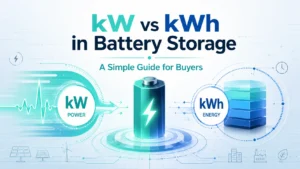
Battery energy in kWh and inverter power in kW do not need to be numerically equal. A 10kW inverter can be paired with different battery capacities depending on simultaneous load, required runtime and battery discharge capability. The kW vs kWh battery storage guide explains how to size power and energy as separate system requirements.
Do not connect a battery to equipment certified only for a PV input. UL Solutions warns that a PV-only inverter connected to a battery source can experience hazardous failure because battery fault behaviour differs from PV input behaviour. (UL Solutions)
Not Sure Which Inverter Architecture Fits Your Project?
Share your existing solar setup, inverter model, battery voltage, required capacity and backup needs. EASYWAY can help you compare compatible low-voltage and high-voltage battery configurations for hybrid or AC-coupled systems.
For installers, distributors and energy storage projects.
How EASYWAY Battery Systems Are Matched With Inverters
The EASYWAY energy storage product range includes low-voltage residential batteries, high-voltage modular systems and integrated commercial and industrial energy storage cabinets. These products use different voltage architectures, capacities and expansion methods, so they cannot be paired with one universal inverter specification. (Leading Lithium Battery Manufacturer)
The EASYWAY battery project references show model-specific combinations with inverter platforms including Solis, Deye and Solinteg. Examples range from 10kWh and 16kWh low-voltage home systems to 20kWh and 46kWh high-voltage clusters and integrated 215kWh/100kW or 261kWh/125kW cabinets. (Leading Lithium Battery Manufacturer)
These examples illustrate two important rules:
- The inverter must match the battery voltage architecture and communication protocol.
- A configuration used in one project should not be assumed compatible with every inverter model from the same brand.
Installers and distributors should confirm the exact battery model, inverter model, firmware, phase requirement, target capacity and backup function before finalising a system.
Hybrid Inverter vs Battery Inverter Decision Matrix
| Project situation | Usually assess first | Main reason |
|---|---|---|
| New solar and battery installation | Hybrid inverter | Integrated PV and battery control |
| Existing string-inverter solar system | Battery inverter | Adds storage without replacing working PV equipment |
| Existing microinverter system | Battery inverter | Supports AC-coupled retrofit |
| Solar now, battery within a short confirmed period | Hybrid inverter | Battery port may simplify later installation |
| Solar now, battery timing or model uncertain | Standard PV inverter plus future battery inverter | Reduces dependence on one future battery ecosystem |
| Limited equipment space | Hybrid inverter | Combines major conversion functions |
| Multiple existing PV systems | Battery inverter | Can connect storage at the shared AC level |
| Primary goal is outage backup | Compare backup architecture, not label | Both options require model-specific backup capability |
| Commercial retrofit | Battery inverter or AC-coupled PCS | Existing generation can remain in service |
| New integrated C&I project | Project-specific hybrid or PCS architecture | Power, energy and grid-control requirements dominate |
Frequently Asked Questions
What Is a Hybrid Inverter?
A hybrid inverter combines solar PV conversion and bidirectional battery power conversion in one device. It can manage energy between solar panels, a compatible battery, building loads and the grid. Backup power, generator input and grid export remain model- and market-dependent.
What Is a Battery Inverter?
A battery inverter converts stored battery DC into AC electricity and converts AC electricity into the DC form required for battery charging. It normally does not include direct solar PV inputs, so a separate string inverter or microinverters manage the solar array.
Is a Hybrid Inverter the Same as a Solar Inverter?
A hybrid inverter includes solar-inverter functions, but a standard solar inverter normally cannot connect directly to a battery. The hybrid model adds a battery port, bidirectional conversion and energy-management controls.
Can a Hybrid Inverter Work Without a Battery?
Many hybrid inverters can initially operate as normal grid-connected solar inverters without a battery, but this is model-specific. Buyers should confirm operating modes, backup limitations and whether battery-free commissioning is supported.
Can I Add a Battery Inverter to Existing Solar Panels?
Yes. A battery inverter can usually be added on the AC side of an existing solar system, subject to equipment compatibility, metering, electrical design and local grid requirements. This is a common retrofit approach for string-inverter and microinverter systems.
Does a Hybrid Inverter Work During a Power Cut?
Only when the model has backup capability and the complete installation includes a compatible battery, grid-isolation equipment and properly configured backup circuits. A grid-connected hybrid inverter without these elements may still shut down during an outage.
Is a Hybrid Inverter More Efficient?
A DC-coupled hybrid system can require fewer conversion stages when solar energy charges a battery. Actual system efficiency depends on the inverter, battery, operating mode, temperature and load profile, so the architecture alone does not guarantee better annual performance.
Can Any Battery Work With Any Hybrid Inverter?
No. The battery must match the inverter’s voltage range, current limits and communication protocol. The exact model and firmware should appear on the manufacturer’s supported battery list or be confirmed through formal compatibility documentation.
Conclusion
The main difference between a hybrid inverter and a battery inverter is the solar connection.
A hybrid inverter combines direct solar PV inputs and battery conversion in one coordinated device. It is commonly the simpler choice for a new solar-plus-storage project.
A battery inverter manages the battery separately from the solar inverter. It is commonly the more practical choice when storage is added to an existing string-inverter or microinverter installation.
The final decision should follow this order:
- Determine whether the project is new or a retrofit.
- Decide between DC-coupled and AC-coupled storage.
- Define the required solar, battery and backup power.
- Confirm battery voltage and inverter compatibility.
- Check continuous output, peak output and battery capacity.
- Verify backup behaviour during a grid outage.
- Confirm local grid-interconnection approval.
- Evaluate future expansion and component replacement.
A hybrid inverter is not automatically better because it combines more functions. A battery inverter is not automatically less efficient because it uses AC coupling. The correct solution is the architecture that matches the existing equipment, battery, loads, backup requirement and long-term project plan.