Choosing the right battery capacity is only one part of a home energy storage project. The installation location also affects fire safety, charging performance, battery life, maintenance access and total project cost.
For UK homes, the main options are an outdoor wall, a detached or attached garage, a utility room or another dedicated service area. A loft may appear convenient, but current UK guidance excludes lofts and roof spaces as battery installation locations.
This guide compares the most common locations for photovoltaic battery storage and explains how to choose a battery that matches the property, climate and installation environment.
Key Takeaways
- A solar battery can be installed indoors or outdoors, but the manufacturer must approve the selected environment.
- PAS 63100:2024 states that storage batteries should be installed outdoors where practicable.
- Batteries should not be installed in lofts, roof spaces, bedrooms, escape routes or basements without outdoor access.
- An outdoor battery needs more than a suitable IP rating. Charging temperature, heating, sunlight, drainage and impact protection also matter.
- A detached garage or suitable outbuilding often offers a practical balance between weather protection and separation from living spaces.
- Battery location can change the total installed cost through longer cables, heaters, ventilation, fire-resistant construction and protective barriers.
Where Is the Best Place to Install a Solar Battery?
The best place to install a solar battery is a non-habitable, accessible and temperature-appropriate location that does not obstruct an escape route. It must also comply with the battery manufacturer’s instructions and applicable UK electrical and fire-safety requirements.
For many properties, the strongest options are:
- A suitable detached garage or non-habitable outbuilding
- An attached garage with appropriate fire separation
- A sheltered outdoor wall away from doors and windows
- A dedicated utility or plant room
- A suitable basement with direct access to the outside
The correct location depends on both the building and the selected battery. An outdoor-ready battery may perform well on a shaded external wall, while an indoor model requires a properly designed internal space.
Quick Solar Battery Location Comparison
| Location | General suitability | Main advantages | Main concerns |
|---|---|---|---|
| Detached garage or outbuilding | Often suitable | Separated from living areas and protected from direct weather | Winter temperature, cable distance and security |
| Attached garage | Potentially suitable | Accessible and usually sheltered | Fire separation, vehicle impact and stored fuels |
| Outdoor wall | Potentially suitable | Saves indoor space and separates equipment from living rooms | Weather, sunlight, drainage and low temperatures |
| Utility room | Possible with suitable design | Stable temperature and convenient maintenance | Ventilation, fire separation, noise and escape routes |
| Basement | Requires assessment | Secure and often temperature-stable | Flooding, moisture, ventilation and emergency access |
| Loft or roof space | Not suitable under PAS 63100 | Saves floor space | Fire safety, heat, structural loading and difficult access |
Indoor vs Outdoor Solar Battery Installation
Indoor and outdoor installations manage different risks. Indoor installation protects the system from rain and extreme weather, but places the battery closer to occupants. Outdoor installation provides more separation from living areas, but exposes the equipment to temperature changes, moisture and physical impact.
Advantages of Installing a Solar Battery Indoors
A suitable indoor space usually provides a narrower and more stable temperature range. It can protect the battery from rain, frost, direct sunlight and salt air while making inspection and maintenance easier.
Indoor installation may also improve Wi-Fi connectivity and reduce the energy required for low-temperature heating. However, a stable temperature alone does not make an indoor location suitable.
The room must still provide adequate ventilation, fire separation, detection and servicing space. It must not obstruct a staircase, landing, corridor or another escape route.
Disadvantages of Indoor Battery Installation
An indoor battery can occupy valuable utility or storage space. The battery and inverter may also generate heat, fan noise or relay sounds that become noticeable near bedrooms, offices and living areas.
Indoor installation may require additional work, including:
- Fresh-air ventilation to the outside
- Fire-resistant walls, floors or ceilings
- Interlinked smoke or multi-sensor detection
- Removal of nearby combustible storage
- Additional maintenance clearances
A household cupboard should not automatically be treated as a battery cabinet. A small enclosed space can trap heat and restrict maintenance access.
Advantages of Installing a Solar Battery Outdoors
An outdoor battery preserves indoor space and separates the equipment from frequently occupied rooms. Noise from fans, relays or the inverter is also less likely to disturb residents.
Outdoor installation can be especially useful when a property has no garage or suitable utility room. It may also provide more space for future battery expansion.
Disadvantages of Outdoor Battery Installation
An outdoor system must tolerate the actual environmental conditions at the property. Important risks include:
- Low-temperature charging restrictions
- Heating energy consumption
- High temperatures caused by direct sunlight
- Rain, condensation and salt corrosion
- Theft or unauthorised access
- Impact from vehicles, tools or garden equipment
- Longer electrical and communication cable routes
Moving a battery outside does not remove the need for careful site assessment.
Can Solar Batteries Be Installed Outside in the UK?
Yes. Solar batteries can be installed outside in the UK when the complete system is approved for outdoor use and positioned according to the manufacturer’s instructions and current installation requirements.
PAS 63100 recommends outdoor installation where practicable. However, an outdoor battery should not be installed within one metre of an escape route, door, window or ventilation opening.
Check the Complete Battery System
Do not check only the battery enclosure. Confirm whether all relevant components are suitable for the proposed environment, including:
- Battery modules and control unit
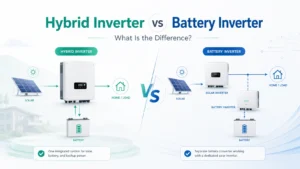
- Hybrid or battery inverter
- AC and DC isolators
- Connectors and cable glands
- External junction boxes
- Communication and monitoring equipment
An outdoor-rated battery does not make an indoor-only inverter suitable for installation beside it.
Understand the Battery IP Rating
The IP rating describes an enclosure’s protection against solid objects and water under defined test conditions. IP65 is commonly used for outdoor-ready residential batteries, but it does not mean the equipment can be installed anywhere outside.
An IP-rated battery should still be kept away from:
- Standing water and flood-prone areas
- Leaking gutters and roof drainage
- Locations with blocked drainage or ventilation
- Unapproved mounting orientations
- Direct pressure washing
The installer must also follow the specified cable-entry direction, wall clearances and mounting method.
Check the Charging Temperature
Battery datasheets may show different charging, discharging, storage and recommended operating temperatures. These values are not interchangeable.
A lithium battery may continue discharging during cold weather while its battery management system prevents charging. In that condition, the battery can still power the home but may not accept new solar generation until its cells warm up.
For cold-weather installations, check:
- The minimum charging temperature
- Whether charging resumes automatically
- Whether the battery contains an integrated heater
- When the heater activates
- How much energy the heater consumes
Avoid Direct Sunlight and Poor Drainage
A weather-resistant enclosure can still overheat on a south- or west-facing wall during summer. Where possible, select a shaded and ventilated position that remains accessible for servicing.
The battery should be installed above expected standing-water or flood levels and away from leaking gutters, downpipes and areas where snow or leaves can accumulate.
Mechanical protection may also be needed when the equipment is beside a driveway, parking area, garage or working space.
Can You Install a Solar Battery in the Loft?
No. PAS 63100:2024 excludes voids, roof spaces and lofts as locations for storage batteries.
A solar battery in the loft may appear attractive because it remains hidden, does not occupy ground-floor space and may be close to rooftop solar cabling. However, a typical loft creates several practical and safety problems:
- High summer temperatures beneath the roof
- Large daily and seasonal temperature changes
- Difficult access for inspection and emergency response
- Timber structures and combustible insulation
- Possible roof leaks or condensation
- Uncertain floor-loading capacity
- Difficult removal and replacement of heavy modules
A complete battery system can weigh well over 100 kilograms once multiple modules, a base and control equipment are combined. Structural capacity must therefore be considered even in locations that are otherwise permitted.
Better alternatives to loft installation may include:
- A narrow wall-mounted battery in a compliant utility room
- A floor-standing system in a garage
- A modular system in a detached outbuilding
- An outdoor-ready battery on a suitable external wall
Is a Garage a Good Place for Home Battery Storage?
A garage can be one of the most practical battery locations because it separates the system from living areas while protecting it from direct rain and sunlight.
However, the garage must still be assessed for temperature, fire separation, physical impact and combustible storage.
Installing a Battery in an Attached Garage
An attached garage should be checked for:
- Fire-resistant separation from the home
- Doors or openings leading into the dwelling
- Vehicle impact
- Petrol, paint, solvents or gas cylinders
- Winter temperature
- Humidity and airflow
- Required maintenance clearance
The battery should not be placed where a vehicle can strike it or where stored materials block airflow and servicing access.
Installing a Battery in a Detached Garage or Outbuilding
A detached garage or non-habitable outbuilding often provides a strong balance between separation and environmental protection.
The installer should still evaluate:
- Lowest winter temperature
- Cable length and voltage drop
- Communication signal strength
- Water entry and drainage
- Physical security
- Fire detection
- Access to emergency isolation
A longer cable route can increase the installed cost and may require larger conductors. The battery and inverter manufacturers may also specify maximum power and communication cable lengths.
How to Choose a Battery for the Installation Location
The installation environment should be defined before selecting a battery model.
Compare these specifications:
- Indoor or outdoor approval
- IP and mechanical-impact ratings
- Minimum charging temperature
- Integrated low-temperature heating
- Wall-mounted, rack-mounted or stackable format
- Required service clearances
- Low-voltage or high-voltage architecture
- Compatible inverter models
- Parallel expansion limits
- Applicable safety documentation
The EASYWAY home battery storage solutions page separates residential batteries by installation scenario, voltage, mounting format and expansion needs. The range includes systems designed for indoor use, outdoor-ready stackable batteries and low-voltage wall-mounted batteries with low-temperature heating.
This illustrates an important selection principle:
Choose the installation environment first, and then shortlist batteries documented for that environment.
For common 51.2V residential backup and solar self-consumption projects, installers can also compare wall-mounted and rack-mounted formats in the EASYWAY low-voltage battery range.
The final choice must still match the inverter voltage, communication protocol, required capacity and local installation conditions.
Does Battery Location Affect Installation Cost and ROI?
Yes. The least expensive battery is not always the lowest-cost installed system.
Battery location can change the cost of:
- Electrical and communication cables
- Wall penetrations
- Fire-resistant construction
- Outdoor ventilation
- Impact barriers
- Weather protection
- Lifting and access equipment
- Low-temperature heating
- Future maintenance
For example, an outdoor location may avoid internal building work but require a longer cable route, protective barrier and heated battery. An indoor utility room may shorten the cable route but require ventilation and fire-resistant separation.
These costs should be included before calculating the project’s payback period. The method in this solar battery ROI formula and payback guide can help compare the full installed cost rather than the battery purchase price alone.
Not Sure Which Battery Fits Your Installation Location?
Share your target capacity, inverter model, installation environment and local temperature range. EASYWAY can help you compare suitable indoor, outdoor and low-temperature home battery options.
For installers, distributors and residential ESS projects.
Final Solar Battery Location Checklist
Before approving a battery location, confirm that:
- The battery is approved for the proposed indoor or outdoor environment.
- The location does not obstruct an escape route.
- It is not in a bedroom, loft, roof space or unsuitable basement.
- Outdoor equipment is at least one metre from doors, windows, ventilation openings and escape routes.
- Charging and discharging temperatures match the local climate.
- Any required low-temperature heater is included.
- The wall or floor can support the complete system.
- The battery is protected from flooding, direct sunlight and physical impact.
- Ventilation and fire detection requirements have been addressed.
- Cable lengths comply with manufacturer limits.
- The inverter is compatible with the battery.
- The location allows inspection, isolation and future replacement.
- Installation in the proposed location does not affect the warranty.
Frequently Asked Questions
Can Solar Batteries Be Installed Outside in the UK?
Yes. The battery and related equipment must be approved for outdoor use and installed according to the manufacturer’s instructions and PAS 63100. The location must account for weather, temperature, impact protection and separation from doors, windows and escape routes.
Can You Install a Solar Battery in a Loft?
No. PAS 63100:2024 excludes voids, roof spaces and lofts as battery installation locations.
Can a Home Battery Be Installed in a Garage?
Yes, provided the garage has an appropriate design. Fire separation, vehicle impact, combustible storage, ventilation and winter temperature must all be assessed.
Is a Utility Room Suitable for a Solar Battery?
A utility room may be suitable when it is not part of an escape route or sleeping area and can provide the required ventilation, fire separation, detection and servicing space.
Does an Outdoor Solar Battery Need a Heater?
Not every outdoor battery needs a heater. However, the battery must remain within its permitted charging temperature. In colder areas, integrated heating can reduce winter charging interruptions.
How Far Should an Outdoor Battery Be From a Window?
PAS 63100 excludes outdoor battery installation within one metre of doors, windows, escape routes and ventilation openings. The manufacturer or site assessment may require additional separation.
Does Battery Location Affect Efficiency?
Yes. Low or high temperatures can restrict battery power, while longer cable routes may increase electrical losses or require larger conductors. Heating also consumes energy.
Does Battery Location Affect the Warranty?
It can. Installing an indoor-only battery outside, ignoring required clearances or operating the system outside its specified environmental range may affect warranty coverage.
Conclusion
The best battery location is not determined by a single rule such as “indoors lasts longer” or “outdoors is safer.”
For a UK home, the decision should follow this order:
- Exclude prohibited and unsafe locations.
- Assess outdoor, garage and outbuilding options.
- Select batteries approved for the environment.
- Verify temperature, ventilation and fire requirements.
- Check cable routes and inverter compatibility.
- Compare the complete installed cost.
A detached outbuilding, appropriately separated garage or compliant outdoor location will often provide a practical balance between separation, environmental protection and maintenance access.
A dedicated indoor utility or plant room may also be suitable when the required ventilation, fire separation and detection are included.
A loft should not be used as a battery installation location under PAS 63100.
Ultimately, a safe solar battery storage installation is a complete system decision. The battery, inverter, building layout, climate and electrical design must all support the same proposed location.