Key Takeaways
- Europe’s energy storage certification system is a multi-layer compliance stack combining EU directives, EN standards, and national grid codes.
- Grid compliance (especially EN 50549-10) is becoming more critical than basic safety certification.
- Certification is no longer just regulatory—it directly determines project bankability, insurance eligibility, and grid participation rights.
- Residential and commercial ESS follow different compliance intensity levels, but both are converging toward stricter grid-support capabilities.
- Early compliance planning significantly reduces time-to-market and total certification cost.
- Manufacturers who design systems around certification requirements gain a structural advantage in EU market entry.
1. Why Certification Defines Market Access in Europe
The European energy storage market is transitioning from technology-driven competition to compliance-driven competition.
In practical terms, this means:
- A high-performance battery system without certification is commercially non-existent.
- Grid operators prioritize certified behavior over theoretical capability.
- Investors and insurers increasingly treat certification as a risk filter mechanism.
Energy storage systems (ESS) are no longer passive components. They are now considered active grid infrastructure assets, required to stabilize voltage, frequency, and energy flow dynamics.
This shift has transformed certification into a core design constraint, not an afterthought.
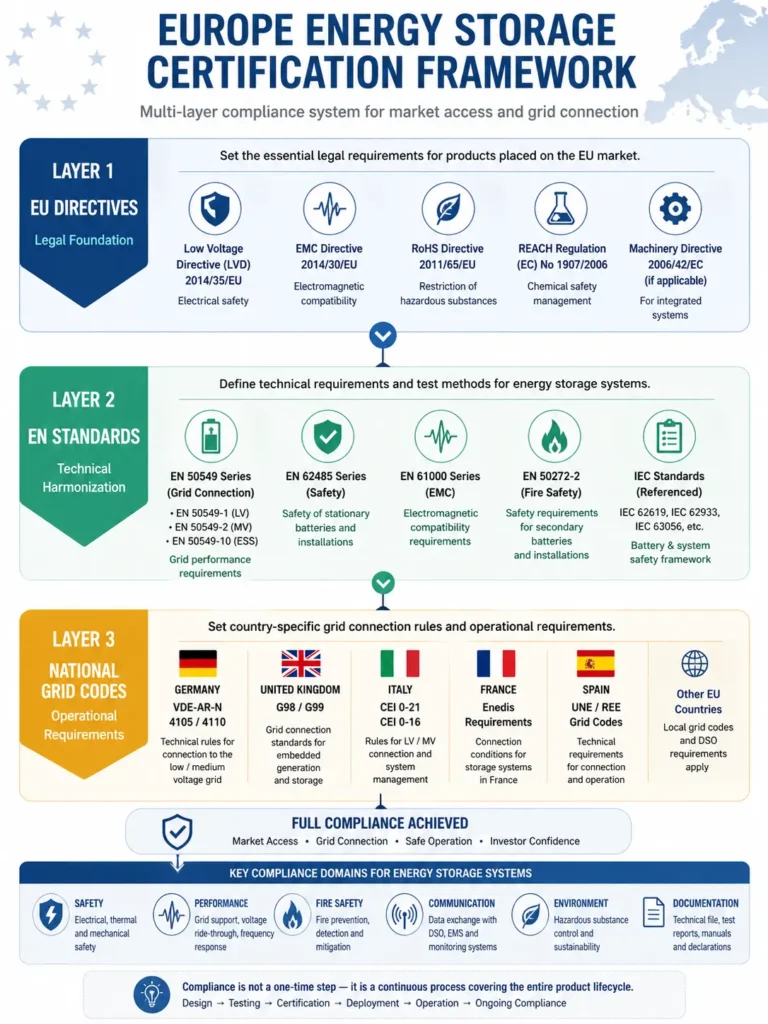
2. The European Compliance Architecture (Multi-Layer System)
European ESS certification is structured across three interdependent layers:
Layer 1: EU Directives (Legal Foundation)
These define baseline legal compliance:
- Low Voltage Directive (LVD)
- Electromagnetic Compatibility (EMC Directive)
- RoHS / REACH environmental compliance
Layer 2: EN Standards (Technical Harmonization)
These define system behavior expectations:
- EN 50549 series (grid connection rules)
- EN 62485 (battery installation safety)
- EN 61000 (electromagnetic performance)
Layer 3: National Grid Codes (Operational Reality)
Each country adds localized constraints:
- Germany: VDE-AR-N 4105 / 4110
- UK: G98 / G99
- Italy: CEI 0-21 / CEI 0-16
- France: Enedis technical guidelines
Compliance Structure Overview
| Layer | Purpose | Impact Level |
|---|---|---|
| EU Directives | Legal access to market | Mandatory |
| EN Standards | Technical harmonization | Mandatory for certification |
| National Codes | Grid connection approval | Project-critical |
3. Core Certification Stack for Energy Storage Systems
3.1 CE Marking: The Market Entry Gate
CE certification confirms compliance with:
- Electrical safety
- EMC stability
- Environmental restrictions
Without CE marking, ESS products cannot legally circulate in the EU market.
3.2 Battery Safety Standards (IEC Framework)
Modern ESS systems must comply with:
- IEC 62619 → Industrial lithium battery safety
- IEC 63056 → Emerging stationary storage benchmark
- IEC 62933 → System-level ESS architecture safety
These standards ensure:
- Thermal stability under extreme load
- Controlled failure behavior
- Electrical isolation integrity
3.3 Transport Compliance (UN38.3)
Before deployment, lithium systems must pass:
- Shock & vibration testing
- Thermal cycling
- Pressure and altitude simulation
This ensures ESS units are safe during global logistics chains.
4. Grid Compliance: The Real Bottleneck in Europe
Unlike safety certification, grid compliance determines whether a system can operate at all.
4.1 EN 50549 Series (Core Grid Standard)
- EN 50549-1 → Low voltage systems
- EN 50549-2 → Medium voltage systems
- EN 50549-10 → Advanced dynamic grid behavior testing
Key functional requirements:
- Voltage ride-through capability (LVRT / HVRT)
- Reactive power support
- Frequency response regulation
- Fault behavior stability
Grid Behavior Shift (Simplified Model)
| Traditional Inverter | Modern ESS (EN 50549-10) |
|---|---|
| Passive response | Active grid stabilization |
| Fixed output logic | Adaptive power control |
| Fault shutdown | Fault ride-through support |
4.2 Rise of Grid-Forming ESS
A major evolution in 2025+ standards is the shift toward:
“Energy storage must behave like a grid stabilizer, not just a power injector.”
This includes:
- Sub-10ms frequency response
- Synthetic inertia support
- Autonomous voltage balancing
5. Fire Safety & Installation Compliance (High-Risk Domain)
Fire safety is one of the fastest-evolving regulatory areas in Europe due to increasing ESS deployment density.
Key standards:
- EN 62485 series → Stationary battery installation
- EN 50272-2 → Safety requirements for battery systems
- Thermal runaway containment guidelines
Many projects also reference:
- UL 9540 / 9540A (global benchmark for fire propagation testing)
Risk-Control Layers in ESS Design
- Cell-level protection (thermal monitoring)
- Module isolation systems
- Rack-level suppression
- Container-level ventilation and fire containment
6. Residential ESS Certification Requirements (2026 Outlook)
Residential systems have lower complexity but increasingly strict compliance expectations.
Mandatory requirements:
- CE marking
- IEC 62619 battery safety
- EMC compliance (EN 61000 series)
- UN38.3 transport certification
Emerging expectations:
- VDE 2510-50 system safety validation
- UL 9540A fire propagation testing (often requested by insurers)
- Smart grid communication compatibility
Residential sizing logic (real-world deployment factor)
A typical 5kW solar system often requires carefully matched storage sizing for efficiency optimization. A practical breakdown is explained in this guide:
👉 Best Battery Size for a 5kW Solar System
7. Commercial & Industrial ESS: Higher Compliance Complexity
Commercial systems introduce multi-dimensional compliance:
Additional requirements:
- Grid service qualification testing
- Peak shaving & load balancing validation
- Frequency regulation certification
System-level certification needs:
- TÜV system validation
- IEC 62933 compliance framework
- Insurance-grade documentation
ROI & Certification Linkage
In commercial deployment, certification directly affects financial performance:
- Faster grid approval → earlier revenue generation
- Higher reliability score → better financing terms
- Lower risk classification → reduced insurance cost
A detailed breakdown of financial returns is available here:
👉 Commercial Energy Storage ROI in 2026
Start Your Energy Storage Journey Today
From residential to commercial-scale energy storage solutions, we help you reduce energy costs, improve efficiency, and achieve energy independence with scalable systems from 5kWh to 1.93MWh, backed by triple-tier certification (CE, IEC 62619, and UL 1973).
8. Certification Workflow (End-to-End Lifecycle)
Step-by-step process:
- Product architecture design (compliance-aware)
- Prototype validation testing
- IEC/EN type testing
- Grid compliance simulation
- Fire safety testing
- CE declaration of conformity
- Market approval + ongoing surveillance
Common delays:
- Grid test scheduling backlog
- Multi-country code inconsistencies
- Fire safety validation iterations
9. Strategic Market Insight: Certification as Competitive Moat
Certification in Europe is no longer a checkbox—it functions as a market filter and competitive barrier.
Companies with mature certification pipelines achieve:
- Faster market entry
- Lower project friction
- Higher EPC acceptance rate
- Stronger investor confidence
This is why leading providers increasingly offer integrated system-level solutions such as:
👉 Energy Storage Solutions for Europe
These solution frameworks reduce complexity by aligning:
- Hardware design
- Grid compliance requirements
- Certification documentation
- Deployment architecture
10. Future Outlook (2026–2030)
Europe’s ESS certification landscape is moving toward:
1. Fully harmonized EU grid codes
Reduced fragmentation across countries
2. Performance-based certification
Not only safety—but dynamic grid behavior validation
3. Digital certification systems
Blockchain-style compliance tracking (emerging concept)
4. AI-assisted compliance verification
Automated pre-certification simulation models
11. Conclusion: Compliance as the New Energy Infrastructure Layer
Energy storage systems in Europe are entering a phase where:
“Certification equals operational permission.”
The companies that succeed will not necessarily be those with the best hardware, but those who:
- Design around compliance from day one
- Understand grid behavior requirements deeply
- Integrate certification into product architecture
In this environment, certification is not a barrier—it is a design language for market access.