Choosing the right solar battery is no longer just about storing extra electricity from solar panels. In 2026, homeowners, installers, distributors, EPC companies, and commercial energy storage buyers are looking for batteries that are safer, longer-lasting, easier to scale, and better prepared for stricter global compliance requirements.
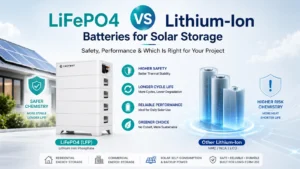
That is why LiFePO4 solar batteries, also known as lithium iron phosphate batteries or LFP batteries, have become one of the most important technologies in modern solar energy storage.
Compared with traditional lead-acid batteries and many other lithium-ion chemistries, LiFePO4 batteries offer a strong balance of safety, cycle life, usable capacity, efficiency, and long-term cost value. For daily solar charging and discharging, this makes them especially suitable for residential solar storage, commercial battery systems, off-grid projects, and backup power applications.
For buyers planning a solar battery project, EwayEnergy provides a range of low-voltage LiFePO4 battery solutions, high-voltage battery systems, and commercial and industrial energy storage solutions for different project requirements.
Quick Answer: Why Are LiFePO4 Batteries Good for Solar Storage?
LiFePO4 batteries are good for solar energy storage because they are safer, more thermally stable, longer-lasting, and more suitable for deep daily cycling than many other battery types. A well-designed LiFePO4 battery system can support thousands of charge and discharge cycles, deliver stable power output, require little maintenance, and reduce long-term replacement costs.
For solar projects, this matters because batteries are not used occasionally. They may charge during the day, discharge at night, provide backup during outages, and support self-consumption or peak shaving every day. A battery chemistry that can handle frequent cycling is essential.
In 2026, this is not only a technical preference. It is also an industry trend. According to the IEA’s 2026 battery storage market update, LFP batteries have become one of the dominant chemistries in stationary energy storage due to their lower cost, long lifetime, safety advantages, and suitability for frequent cycling.
What Is a LiFePO4 Solar Battery?
A LiFePO4 solar battery is a rechargeable lithium battery that uses lithium iron phosphate as the cathode material. It is part of the broader lithium-ion battery family, but its chemistry is different from NMC, NCA, or LCO batteries that are often used in electric vehicles, electronics, or high-energy-density applications.
For solar energy storage, the most important difference is that LiFePO4 prioritizes:
- Safety
- Long cycle life
- Thermal stability
- Deep discharge capability
- Stable voltage output
- Lower long-term ownership cost
- Better suitability for stationary storage
Other lithium-ion chemistries may offer higher energy density, which is useful when space and weight are the top priorities. However, stationary solar storage usually has different priorities. In a home, commercial building, telecom site, farm, or off-grid system, buyers often care more about safety, lifespan, system reliability, and predictable performance.
That is why LiFePO4 has become one of the preferred choices for solar battery storage.
2026 Solar Battery Market Update: Why LFP Is Becoming the Default Choice
The solar battery market has changed quickly. A few years ago, many buyers compared lithium batteries mainly with lead-acid batteries. In 2026, the question is different: buyers increasingly ask which lithium chemistry is most suitable for stationary storage.
The answer is often LFP.
Global energy storage demand continues to rise as more solar and wind capacity is connected to the grid. Battery storage is playing a key role in improving renewable energy utilization, reducing curtailment, supporting backup power, and helping commercial users manage electricity costs.
For solar storage buyers, several 2026 market trends are especially important:
- LFP is becoming the mainstream chemistry for stationary storage because safety and cycle life matter more than maximum energy density.
- Battery storage duration is moving from short backup toward longer daily energy shifting.
- Commercial and industrial users are paying more attention to peak shaving, time-of-use optimization, and solar self-consumption.
- European buyers are increasingly concerned about documentation, traceability, battery passport preparation, and compliance with the EU Battery Regulation.
- Inverter compatibility, BMS communication, and project-based configuration are becoming key purchase factors.
This means battery buyers should no longer evaluate a product only by price per kWh. They should consider the full project lifecycle, including safety, usable capacity, replacement cost, installation method, compliance documents, and after-sales support.
Key Advantage 1: Safer Chemistry and Better Thermal Stability
Safety is one of the biggest reasons LiFePO4 batteries are widely used in solar storage.
LiFePO4 chemistry uses a phosphate-based cathode structure. The phosphorus-oxygen bond in this structure is strong, making the material more resistant to oxygen release under heat or stress. This is important because oxygen release can contribute to thermal runaway in some battery chemistries.
Compared with many other lithium-ion batteries, LiFePO4 batteries generally have better thermal stability and a higher resistance to overheating. They also do not contain cobalt, which helps reduce certain supply chain and safety concerns.
For solar storage, this safety advantage is especially important in:
- Residential energy storage systems
- Indoor or garage installations
- Commercial buildings
- Telecom backup systems
- Off-grid cabins and farms
- Solar-plus-storage projects in hot climates
- Distributor and installer projects where long-term reliability affects reputation
A safe battery still requires correct system design, qualified installation, proper wiring, compatible inverter configuration, and a reliable Battery Management System. But from a chemistry perspective, LiFePO4 offers a strong safety foundation.
For homeowners and installers looking for safer home storage options, EwayEnergy’s low-voltage home battery solutions are designed for residential solar self-consumption, backup power, and flexible capacity expansion.
Key Advantage 2: Long Cycle Life for Daily Solar Charging and Discharging
Solar batteries are usually cycled frequently. In a typical system, the battery charges from solar panels during the day and discharges in the evening or at night. In commercial projects, the battery may also support peak shaving, time-of-use optimization, or backup power.
This makes cycle life one of the most important performance indicators.
A high-quality LiFePO4 battery can typically support thousands of charge and discharge cycles. Actual cycle life depends on cell quality, depth of discharge, temperature, charge and discharge rate, BMS protection, and installation conditions.
This long cycle life helps reduce total cost of ownership. Even if the upfront price of a LiFePO4 battery is higher than a lead-acid battery, the battery may last much longer and require fewer replacements over the life of the solar system.
For B2B buyers, this is especially important. A cheaper battery is not always cheaper if it needs to be replaced more often, causes service calls, or reduces project reliability.
For installers and distributors who need a modular battery option for repeated daily cycling, the UNIV5200 rack-mounted LiFePO4 battery can be used in low-voltage solar storage, telecom backup, off-grid systems, and small commercial applications.
Key Advantage 3: Higher Usable Capacity Than Lead-Acid Batteries
Battery capacity can be misleading if buyers only compare the nominal kWh rating.
For example, a 10kWh lead-acid battery bank and a 10kWh LiFePO4 battery system may look similar on paper. But in real use, the available energy can be very different.
Lead-acid batteries are often limited to around 50% depth of discharge to avoid damage and shorter lifespan. LiFePO4 batteries can usually support much deeper discharge, depending on the BMS settings and manufacturer recommendations.
This means LiFePO4 batteries can reduce oversizing requirements. Instead of buying more nominal capacity to compensate for limited usable capacity, buyers can design a more efficient and compact system.
For example:
| Battery Type | Nominal Capacity | Typical Usable Capacity | Practical Result |
|---|---|---|---|
| Lead-acid battery bank | 10kWh | Around 5kWh | More oversizing may be needed |
| LiFePO4 battery system | 10kWh | Higher usable capacity | More practical stored energy |
For residential solar storage, this difference can directly affect backup time, evening self-consumption, and the number of battery modules required.
Key Advantage 4: Higher Efficiency and More Stable Power Output
Solar energy is valuable because it is generated during limited daylight hours. A battery with poor efficiency wastes part of that energy during charging and discharging.
LiFePO4 batteries usually offer high round-trip efficiency and stable voltage output. This helps reduce energy loss and allows the system to make better use of solar power generated during the day.
This is useful for:
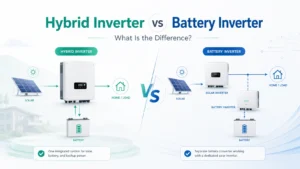
- Hybrid inverter systems
- Off-grid solar systems
- Backup power
- Sensitive electronics
- Commercial loads
- Solar self-consumption systems
- PV-storage-charging applications
A stable discharge curve also helps the system maintain predictable performance as the battery state of charge changes.
For larger residential or small commercial projects that require higher efficiency and scalable capacity, EwayEnergy’s high-voltage battery systems can be used with compatible hybrid inverters to support more advanced solar storage configurations.
Key Advantage 5: Faster Charging and Better Solar Utilization
Solar charging is not always steady. Clouds, shading, seasonality, and short winter daylight hours can all reduce available charging time.
LiFePO4 batteries generally charge faster than lead-acid batteries because they have lower internal resistance and do not require the same long absorption or float charging stages. This is valuable in solar systems because faster recharge helps capture more solar power when sunlight is available.
For off-grid projects, this can be the difference between a battery that reaches full charge and a battery that remains partially charged for long periods.
For commercial users, faster charging can also improve flexibility, especially in systems designed for time-of-use energy management, solar self-consumption, or backup power readiness.
Key Advantage 6: Lower Maintenance and Smarter BMS Protection
LiFePO4 solar batteries require much less maintenance than traditional lead-acid batteries. There is no need for electrolyte refilling, regular equalization charging, or frequent manual checks.
A major reason is the Battery Management System, or BMS.
A good BMS helps protect the battery from:
- Overcharging
- Over-discharging
- Over-current
- Short circuit
- Over-temperature
- Low-temperature charging
- Cell imbalance
- Abnormal communication
- Unsafe operating conditions
In 2026, BMS quality is becoming even more important for B2B buyers. Installers and distributors increasingly need batteries that support inverter communication, state-of-charge monitoring, state-of-health visibility, remote diagnostics, and scalable parallel or high-voltage configurations.
Before purchasing a LiFePO4 battery, buyers should ask whether the battery supports communication protocols such as CAN or RS485, whether it has a clear inverter compatibility list, and whether the supplier can provide technical support for project configuration.
If you are not sure whether your inverter can work with a specific battery model, you can contact EwayEnergy for inverter compatibility support.
Key Advantage 7: Better Fit for Residential, Commercial, and Off-Grid Applications
LiFePO4 batteries are flexible enough for many solar storage applications.
For residential projects, they can support self-consumption, backup power, and energy independence. For commercial projects, they can support peak shaving, load shifting, backup power, and renewable energy utilization. For off-grid projects, they can reduce generator runtime and provide more stable daily power.
Common applications include:
- Home solar battery systems
- Low-voltage 48V or 51.2V storage systems
- High-voltage residential storage systems
- Commercial and industrial energy storage
- Telecom backup power
- Farms and remote sites
- Island and off-grid systems
- Solar-plus-storage charging stations
- Small business backup systems
This broad application range is one reason LFP has become central to both behind-the-meter and utility-scale storage markets.
For commercial buildings, factories, farms, and solar-plus-storage projects, EwayEnergy provides commercial and industrial energy storage solutions with cabinet-style configurations for larger project needs.
Real Project Examples: How LiFePO4 Batteries Are Used in Solar Storage Projects
LiFePO4 batteries are not limited to one type of solar storage system. Depending on the installation space, inverter type, required capacity, and application scenario, buyers can choose rack-mounted, wall-mounted, stackable, or cabinet-style battery solutions.
Below are several typical project configurations using EwayEnergy LiFePO4 battery systems.
1. Rack-Mounted LiFePO4 Battery System for Modular Solar Storage
For installers and distributors who need a flexible and service-friendly battery design, a rack-mounted LiFePO4 system is often a practical choice. Rack-mounted batteries are easy to expand, convenient to maintain, and suitable for residential backup, telecom power, small commercial energy storage, and off-grid solar projects.
One typical configuration uses the UNIV5200 rack-mounted LiFePO4 battery, which is designed for low-voltage solar storage systems. It can be installed in a standard rack cabinet and expanded according to the project’s required capacity.
This type of system is suitable for buyers who need:
- Modular battery expansion
- Easier installation and service
- Stable daily cycling performance
- Low-voltage solar battery configuration
- Backup power for residential or small commercial applications
For more low-voltage configurations, you can explore EwayEnergy’s low-voltage LiFePO4 battery solutions.
2. Stackable High-Voltage Battery System for Residential and Small Commercial Projects
For larger residential solar systems or small commercial applications, a high-voltage stackable battery system can improve system efficiency and support more flexible capacity expansion.
A typical high-voltage project configuration can use a compatible hybrid inverter together with EwayEnergy’s UNIV7600H or UNIV7600HP high-voltage battery system. This type of system is suitable for solar self-consumption, backup power, and higher-capacity residential energy storage projects.
Compared with traditional low-voltage systems, high-voltage LiFePO4 batteries are often preferred when the project requires:
- Higher system efficiency
- Larger usable capacity
- Cleaner installation structure
- Better compatibility with high-voltage hybrid inverters
- Scalable battery expansion
For installers, high-voltage stackable systems can also help create a more premium residential energy storage solution, especially in European solar markets where space, safety, and system appearance are important.
You can view more options on EwayEnergy’s high-voltage battery systems page.
3. Wall-Mounted Low-Voltage Battery System for Home Energy Storage
For homeowners and residential solar installers, wall-mounted LiFePO4 batteries are one of the most popular choices because they save floor space and are easy to integrate into home solar systems.
One example is a low-voltage home energy storage system using a compatible inverter together with the EwayEnergy UNIV-16.2kWhS 51.2V 316Ah LiFePO4 battery pack. One pack provides 16.2kWh of storage capacity, making it suitable for home backup power, solar self-consumption, and daily energy storage.
This type of wall-mounted system is suitable for:
- Residential solar energy storage
- Backup power during outages
- Evening self-consumption
- Larger household electricity demand
- Space-saving installation
- Home energy independence
For residential users, a wall-mounted LiFePO4 battery offers a good balance of safety, capacity, appearance, and installation convenience.
You can explore more residential options through EwayEnergy’s low-voltage home battery solutions.
Need Help Matching the Right Battery System?
Share your inverter brand, system voltage, required capacity, and application scenario. Our team can help confirm compatibility and recommend a suitable battery configuration.
Technical response within 24 hours.
LiFePO4 vs Lead-Acid vs NMC: Which Battery Is Better for Solar?
Different battery chemistries have different strengths. For solar energy storage, the most important factors are usually safety, cycle life, usable capacity, maintenance, and long-term cost.
| Battery Type | Safety | Cycle Life | Usable Capacity | Maintenance | Best Fit |
|---|---|---|---|---|---|
| LiFePO4 / LFP | High | Long | High | Low | Residential, commercial, and off-grid solar storage |
| Lead-acid | Medium | Shorter | Lower | Higher | Low-budget backup or occasional use |
| NMC lithium | Medium to high, depending on design | Medium | High | Low | EVs and compact systems where energy density matters |
| Flow battery | High | Very long | Project-dependent | Medium | Large stationary storage and long-duration applications |
For most solar storage projects, LiFePO4 offers the best balance of safety, cycle life, practical capacity, and cost over time. NMC may still be useful where compact size and high energy density are the top priorities. Lead-acid may still be used in very price-sensitive applications, but its shorter lifespan and lower usable capacity often make it less attractive for daily solar cycling.
How to Choose the Right LiFePO4 Battery for a Solar System
Choosing a LiFePO4 solar battery is not only about selecting a kWh number. A suitable battery system should match the inverter, solar array, load profile, installation environment, backup requirement, and future expansion plan.
1. Choose the Right Battery Voltage
For most residential solar systems, low-voltage LiFePO4 batteries such as 48V or 51.2V systems are widely used because they are flexible, installer-friendly, and compatible with many hybrid inverters.
EwayEnergy’s low-voltage battery solutions are suitable for home storage, small backup systems, off-grid projects, and modular battery expansion.
For larger residential systems or small commercial projects, high-voltage battery systems can provide better efficiency and cleaner system configuration.
For commercial and industrial projects, integrated C&I energy storage cabinets are usually more suitable because they combine battery modules, BMS, thermal management, PCS integration, and system-level control.
2. Match the Battery with the Inverter
Inverter compatibility is one of the most important parts of solar battery selection. Before choosing a LiFePO4 battery, buyers should confirm:
- Battery voltage range
- Charge and discharge current
- CAN / RS485 communication
- BMS protocol compatibility
- Firmware matching
- Approved inverter brands
- Parallel or series expansion limits
For example, a high-voltage stackable system may be matched with compatible hybrid inverters for residential and small commercial use, while a low-voltage wall-mounted system may work better for home backup and self-consumption projects.
If you are not sure whether your inverter is compatible, contact EwayEnergy’s technical team for project-based battery configuration support.
3. Select the Right Installation Type
Different LiFePO4 battery designs are suitable for different applications.
| Installation Type | Best For | Typical EwayEnergy Option |
|---|---|---|
| Rack-mounted battery | Modular storage, telecom, small commercial, off-grid systems | UNIV5200 |
| Wall-mounted battery | Home energy storage, backup power, space-saving installation | UNIV-16.2kWhS |
| Stackable high-voltage battery | Larger residential and small commercial systems | UNIV7600HP |
| C&I cabinet system | Commercial buildings, factories, farms, solar-plus-storage projects | 112kWh / 241kWh / 261kWh ESS |
This makes it easier for installers, distributors, and EPC companies to select the right battery structure based on real project needs.
4. Calculate the Required Capacity
Battery capacity should be based on actual energy usage, not guesswork.
Key questions include:
- What is the daily electricity consumption?
- How many hours of backup are required?
- Which loads are critical?
- Is the system for self-consumption, backup, peak shaving, or off-grid use?
- Will the battery be expanded later?
- What is the usable capacity after depth of discharge and system losses?
For residential systems, 5kWh to 20kWh is common. For commercial projects, capacity may range from tens of kWh to hundreds of kWh or even MWh-scale systems.
5. Review Certifications and Documentation
In 2026, documentation matters more than ever, especially for importers, distributors, EPC contractors, and European buyers.
Recommended documents may include:
- CE
- IEC62619
- UL1973 cell certification
- CE-EMC
- CE-RED
- UN38.3
- MSDS
- Test reports
- Warranty terms
- Installation manual
- BMS communication protocol
- Inverter compatibility list
For B2B buyers, certification and documentation are not just technical details. They reduce project risk, support customs clearance, improve customer trust, and help with regulatory compliance.
2026 Compliance Trend: Why Battery Documentation Matters More
Battery regulations are becoming stricter, especially in the European market.
The EU Battery Regulation is pushing the industry toward stronger requirements for carbon footprint, traceability, performance, durability, safety, labeling, state-of-health information, and battery passports. For rechargeable industrial batteries and energy storage products, buyers should pay closer attention to product documentation, manufacturer traceability, and long-term compliance support.
For solar battery buyers, this means supplier selection should not focus only on price. Buyers should also check whether the manufacturer can provide reliable documentation, compliance support, product traceability, and long-term after-sales service.
This is especially important for distributors and installers selling into the EU market, where customer trust and regulatory readiness can directly affect sales.
EwayEnergy supports B2B buyers with lithium battery solutions for residential and commercial solar storage projects. You can review the full solar battery product range or contact EwayEnergy for model selection and project configuration.
Recommended LiFePO4 Battery Solutions from EwayEnergy
EwayEnergy provides LiFePO4 battery solutions for residential, commercial, and industrial solar energy storage projects. Depending on the system size, inverter type, and application scenario, buyers can choose low-voltage, high-voltage, rack-mounted, wall-mounted, stackable, or cabinet-style battery systems.
For low-voltage home storage and modular solar projects, the UNIV5200 rack-mounted LiFePO4 battery is suitable for installers who need flexible capacity expansion and service-friendly installation. It can be used in residential backup, off-grid solar, telecom power, and small commercial battery storage projects.
For larger home energy storage projects, the UNIV-16.2kWhS 51.2V 316Ah wall-mounted battery pack provides 16.2kWh of storage capacity in one pack. It is suitable for home backup power, solar self-consumption, and space-saving residential installation.
For high-voltage solar storage projects, the UNIV7600H and UNIV7600HP high-voltage battery system are designed for scalable residential and small commercial applications. They can be matched with compatible high-voltage hybrid inverters and are suitable for projects that require higher system efficiency and larger usable capacity.
For commercial and industrial energy storage, EwayEnergy provides integrated ESS cabinet solutions, including 112kWh, 241kWh, and 261kWh systems. These commercial and industrial energy storage solutions are suitable for commercial buildings, factories, farms, solar-plus-storage projects, and PV-storage-charging applications.
Whether you are planning a home solar battery system, a distributor product line, or a commercial storage project, EwayEnergy can support inverter compatibility confirmation, battery configuration, and project-based technical recommendations.
Need Help Choosing the Right LiFePO4 Battery for Your Solar Project?
Every solar storage project has different requirements. A home backup system, a high-voltage residential project, and a commercial energy storage system may all use LiFePO4 batteries, but the battery voltage, inverter compatibility, capacity design, and installation structure can be completely different.
EwayEnergy provides LiFePO4 battery solutions for:
- Low-voltage home energy storage
- High-voltage residential battery systems
- Rack-mounted modular storage
- Wall-mounted home battery systems
- Commercial and industrial energy storage
- OEM/ODM lithium battery projects
Our battery solutions support project-based configuration and are designed for long cycle life, stable performance, and solar storage applications.
To select the right battery for your inverter and project requirements, contact EwayEnergy for technical support.
Final Thoughts: Is LiFePO4 the Best Battery for Solar Storage in 2026?
For most solar energy storage projects, LiFePO4 is one of the best battery choices in 2026.
It offers the safety, cycle life, efficiency, and stability required for daily solar charging and discharging. It is also becoming the dominant chemistry in battery storage deployment, supported by falling costs, stronger market adoption, and better suitability for stationary applications.
For buyers, the best choice is not simply the cheapest battery. The right choice should consider battery chemistry, BMS quality, inverter compatibility, certifications, installation method, expandability, warranty, and supplier support.
A well-designed LiFePO4 solar battery system can provide safer backup power, better solar utilization, and stronger long-term value for residential, commercial, and off-grid energy storage projects.
FAQs About LiFePO4 Solar Batteries
Are LiFePO4 batteries better than lead-acid batteries for solar?
Yes. In most solar storage applications, LiFePO4 batteries are better than lead-acid batteries. They usually offer longer cycle life, higher usable capacity, faster charging, lower maintenance, and better long-term cost performance.
How long do LiFePO4 solar batteries last?
A high-quality LiFePO4 solar battery can often last 10 years or more, depending on cycle life, depth of discharge, temperature, installation quality, and BMS protection. Many LiFePO4 batteries are designed for thousands of cycles.
Are LiFePO4 batteries safe for home energy storage?
LiFePO4 batteries are considered one of the safer lithium battery chemistries because of their stable phosphate structure and higher thermal stability. However, safe installation still requires a qualified battery system, reliable BMS, proper wiring, and compatible inverter configuration.
Can LiFePO4 batteries work with any inverter?
No. A LiFePO4 battery must be matched with a compatible inverter. Buyers should confirm voltage range, charge and discharge current, communication protocol, firmware compatibility, and approved inverter list before installation.
What size LiFePO4 battery do I need for solar?
The required battery size depends on daily energy consumption, backup time, critical loads, solar array size, inverter capacity, and whether the system is for self-consumption, backup, or off-grid use. Residential systems often range from 5kWh to 20kWh, while commercial systems may require much larger capacity.
Are LiFePO4 batteries worth the higher upfront cost?
In many cases, yes. Although LiFePO4 batteries may cost more upfront than lead-acid batteries, their longer lifespan, higher usable capacity, lower maintenance, and better efficiency often reduce total cost over the full system life.
What certifications should solar battery buyers check in 2026?
For B2B solar battery projects, buyers should check relevant certifications and documents such as CE, IEC62619, UL1973 cell certification, UN38.3, MSDS, EMC-related documents, installation manuals, warranty terms, and inverter compatibility documentation.
Are LiFePO4 batteries suitable for commercial energy storage?
Yes. LiFePO4 batteries are widely used in commercial and industrial energy storage because they provide strong safety, long cycle life, good scalability, and reliable performance for peak shaving, backup power, and solar self-consumption.
Which EwayEnergy battery is suitable for modular rack-mounted solar storage?
For modular rack-mounted solar storage, the UNIV5200 rack-mounted LiFePO4 battery is a suitable option for low-voltage solar storage, telecom backup, off-grid systems, and small commercial applications.
Which EwayEnergy battery is suitable for high-voltage solar storage?
For high-voltage residential or small commercial solar storage, the UNIV7600HP high-voltage battery system can be used with compatible hybrid inverters to support scalable capacity and higher system efficiency.
Get a Project-Based Lithium Battery Recommendation
Whether you are planning a home solar battery system, a high-voltage stackable battery solution, or a commercial energy storage project, EASYWAY can help you select a safer and scalable battery configuration.