If you’ve spent any time researching home battery storage, you’ve run into this comparison already: LFP versus NMC. Most articles on the topic land in the same place — “LFP is generally safer and longer-lasting, NMC is more energy-dense” — and then stop, leaving you to figure out what that actually means for the battery sitting in your garage for the next fifteen years.
This guide goes further. We’ll break down the chemistry in plain terms, walk through the data that actually explains why the residential storage industry has shifted decisively toward LFP, and be honest about the narrow cases where NMC still makes sense. Along the way, we’ll look at what these differences mean in practice — including two details that rarely get the attention they deserve: how a battery survives a European winter, and how it survives water.
What you’ll learn:
- The core chemical difference between LFP and NMC, explained without a chemistry degree
- Why over 70% of new residential storage deployments now use LFP, backed by DOE, NREL, and real-world case data
- An honest, quantified look at NMC’s “space advantage” — and whether it actually matters for a home installation
- What separates a genuinely durable LFP battery from one that just claims to be one — cell sourcing, BMS quality, and certification
- Why cold-weather performance and water ingress protection matter more than most chemistry comparisons admit
- A capacity-tier breakdown to help you match the right battery size to your situation
- The Chemistry, Explained Simply
Planning a Solar Battery Storage Project?
If you are comparing battery types, system voltage, capacity, or inverter compatibility, EASYWAY can help you evaluate a suitable lithium battery solution for your project.
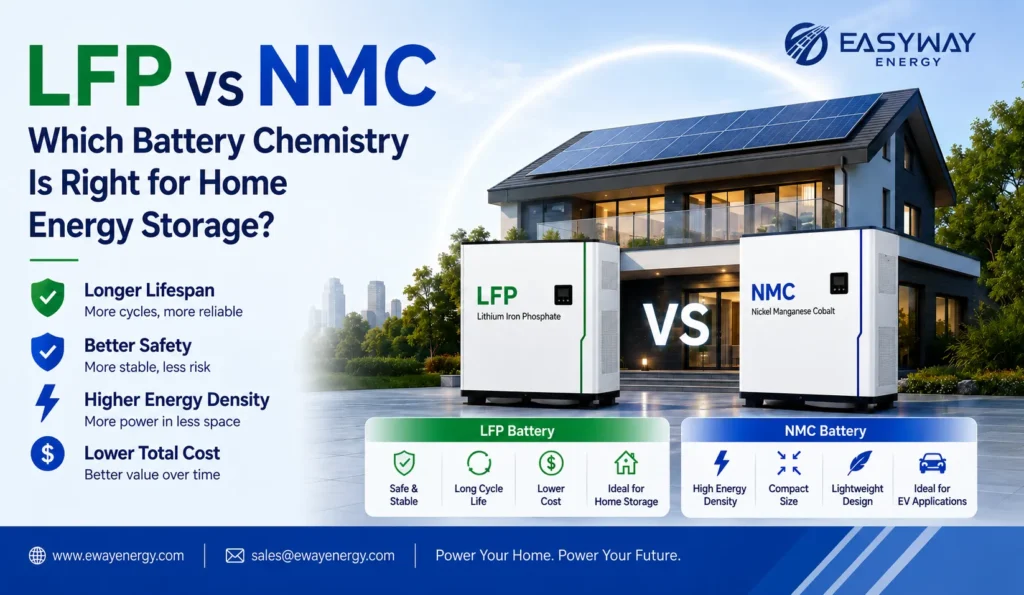
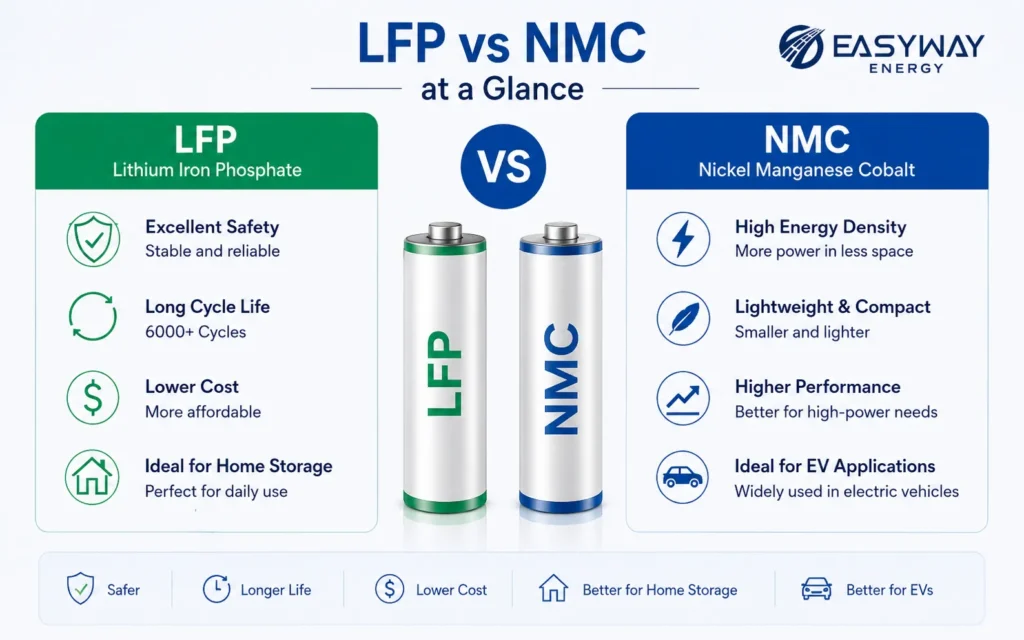
Both LFP and NMC are lithium-ion batteries. The difference between them comes down to one component: the cathode, the positive electrode that lithium ions move toward during discharge.
LFP (Lithium Iron Phosphate, or LiFePO4) uses an iron phosphate cathode arranged in what’s called an olivine crystal structure. This structure is chemically robust — the phosphate-oxygen bonds are strong, which means the material resists breaking down even under heat or stress. The trade-off is a slightly lower voltage per cell (around 3.2V) and a somewhat lower energy density than nickel-based chemistries.
NMC (Nickel Manganese Cobalt) uses a cathode blended from three metals — nickel for capacity, manganese for structural stability, and cobalt for conductivity — arranged in a layered structure that lets lithium ions move more freely. This gives NMC a higher voltage (around 3.7V) and meaningfully higher energy density, which is why it dominates the electric vehicle market, where every kilogram of weight matters.
For a battery sitting in a utility room or garage, weight matters far less than it does in a car. That single fact is the starting point for understanding why the home storage market has moved so decisively toward LFP.
The numbers side by side
| LFP | NMC | |
|---|---|---|
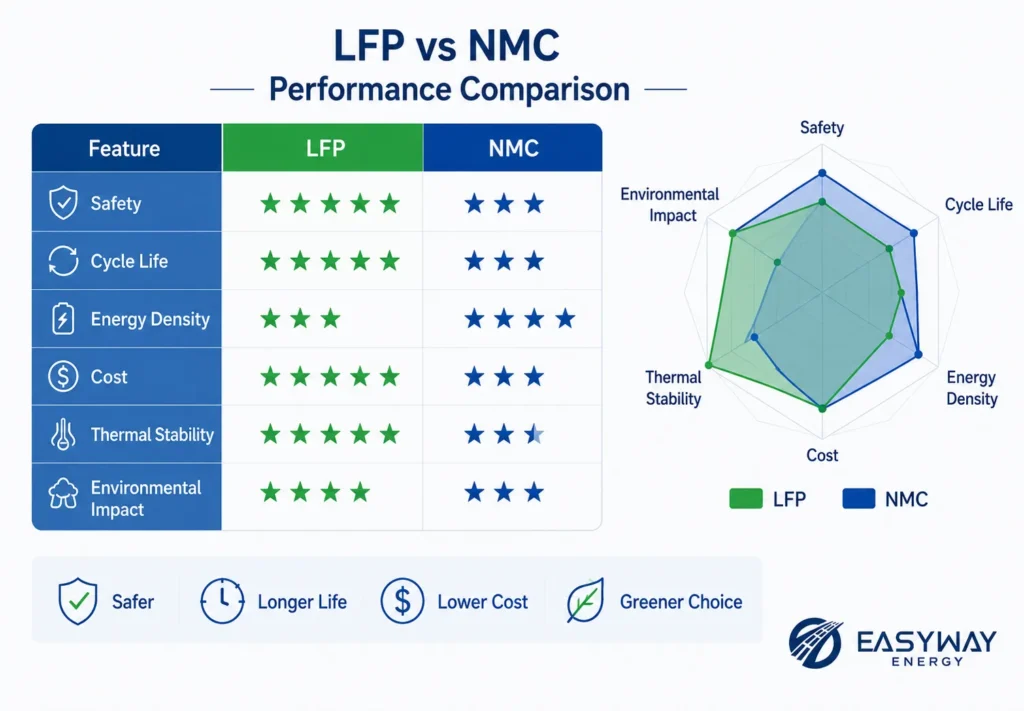
| Energy density | 90–190 Wh/kg | 150–280 Wh/kg |
| Cycle life (to 80% capacity) | 3,000–10,000+ cycles | 1,000–2,500 cycles |
| Thermal runaway onset | ~270°C | ~210°C |
| Cell-level price (2026) | ~$81/kWh | ~$128/kWh |
| Cobalt content | None | Present |
| Typical lifespan (1 cycle/day) | 8–16 years | 3–7 years |
These figures are drawn from 2026 industry pricing data and cycle-life studies — including independently tracked benchmarks from BloombergNEF and recent comparative lifecycle analyses. The gap in cycle life is the number that matters most for a stationary battery that cycles daily: an LFP system rated for 4,000 cycles at one cycle per day lasts over a decade before meaningful degradation, while an NMC system rated for 1,500 cycles needs replacement in four to five years.
Why the Industry Has Shifted Decisively to LFP
This isn’t a marketing claim — it’s a pattern visible across the entire residential storage industry. Virtually every major home battery launched since 2022 uses LFP chemistry, including Tesla’s Powerwall 3, which moved away from the NMC cells used in Powerwall 2.
The evidence behind the shift
The U.S. Department of Energy’s residential storage guidance estimates that LFP systems deliver $3,000–$5,000 more value over a 10-year period than equivalent NMC systems, once you account for replacement costs and total energy throughput over the system’s life. That’s not a marginal difference — it’s often a meaningful share of the original system cost.
Real-world field data backs this up. An 8-year tracking study of 500 residential storage systems found that LFP batteries retained 75–80% of their original capacity at the end of the study period, while comparable NMC batteries had degraded to 60–65% of original capacity over the same timeframe. For a household relying on that battery for daily solar self-consumption, that’s the difference between a system that still meets your evening load in year eight and one that’s noticeably falling short.
Safety data tells a similar story. LFP’s decomposition temperature — the point at which the cathode begins releasing oxygen and risk escalates — sits around 270°C, compared to roughly 210°C for NMC. That 60°C gap is significant in practice: independent 2026 research found thermal runaway approximately 80% less likely in LFP cells under equivalent abuse conditions. This is precisely why Tesla specifies LFP for Powerwall — it’s a battery you sleep twenty feet from.
Fire code requirements reflect this difference directly. A 2023 NFPA analysis found that NMC installations require approximately 30% more clearance space than LFP to meet residential fire safety codes — which, notably, works against NMC’s supposed space advantage, a point we’ll come back to.
What this means for a battery you’re buying today
If you’re sizing a residential system in the 5–16kWh range — the range that covers the vast majority of European and African residential installations — the cycle life and safety advantages of LFP are not subtle. They are the difference between a battery that outlasts the rest of your solar system and one you’re likely to replace once, possibly twice, before the panels themselves need attention.
This is the logic behind EASYWAY’s decision to build its entire residential and commercial product range — from the compact UNIV5100 (5.12kWh) through the high-capacity UNIV-16kWh series and the stackable UNIV7600(H) high-voltage platform — exclusively on LFP chemistry. Every wall-mounted, freestanding, and rack-format battery in the range shares the same underlying cathode material, because in stationary storage, the cycle-life and safety case for LFP isn’t close.
The Honest Case for NMC — and Why It’s Narrower Than You Think
A genuinely useful comparison doesn’t pretend the alternative chemistry has no merits. NMC’s real advantage is energy density: more energy stored per kilogram and per liter of volume. The question worth asking honestly is: how much does that actually matter for a stationary home battery?
Quantifying the “space advantage”
For the same 10kWh of capacity, LFP and NMC packs typically differ in volume by roughly 20–30%. Translated into actual floor space in a garage, utility room, or plant room, that difference usually works out to well under a quarter of a square meter — often closer to the size of a single floor tile.
For the overwhelming majority of installations — a wall-mounted or freestanding unit in a garage, basement, or outdoor enclosure — this difference is not something a homeowner notices day to day. It becomes relevant only in genuinely constrained spaces: a small apartment utility closet, a narrow balcony installation, or a retrofit where every centimeter has already been accounted for.
And as noted above, the fire-clearance requirement gap (NMC needing roughly 30% more safety clearance) eats directly into whatever volumetric advantage NMC has on paper. By the time you account for the clearance code requires around the unit, the real-world footprint difference between a compliant LFP installation and a compliant NMC installation shrinks substantially — in many cases to the point of being negligible.
Where NMC retains a legitimate niche
NMC can still make sense in narrow, specific scenarios: pure standby/backup applications with very light cycling (where the cycle-life gap matters less because the battery rarely cycles), or genuinely space-constrained retrofits where no amount of clearance optimization gets an LFP unit to fit. Outside of those edge cases, the case for NMC in a home storage context has become difficult to justify on the numbers — which is reflected in how far its market share has fallen in stationary storage specifically, even as it remains relevant in electric vehicles where weight is a much bigger factor.
Need Help Matching the Right Battery System?
Share your inverter brand, system voltage, required capacity, and application scenario. Our team can help confirm compatibility and recommend a suitable battery configuration.
Technical response within 24 hours.
What “Grade A Cells” Actually Means — And Why It’s the Detail Most Buyers Skip
Here’s something the LFP-vs-NMC framing tends to obscure: choosing the right chemistry only gets you halfway to a good battery. Within LFP alone, cell quality varies enormously, and this is where a lot of buyers — and a lot of resellers — get caught out.
Not all LFP cells are equal
LFP cells are graded during manufacturing based on consistency of capacity, internal resistance, and defect rate. “Grade A” cells pass the full battery of incoming inspection and quality checks; lower grades — sometimes sold into budget products without clear disclosure — carry higher variance between cells, which translates directly into uneven aging, reduced real-world cycle life, and a higher chance of BMS imbalance issues over the battery’s lifetime.
This is precisely the gap between a battery that claims “LFP chemistry” on a spec sheet and one that performs to the cycle-life numbers in the table above. The chemistry tells you the ceiling of what’s possible. Cell grade and manufacturing quality determine how close to that ceiling the battery you actually buy gets.
EASYWAY sources 100% brand-new Grade A LiFePO4 cells exclusively from top-tier manufacturers — including GOTION, CORNEX, EVE, and DEJIN — with every batch inspected on arrival before it enters production. Manufacturing follows 5S production standards with multi-stage quality control: incoming cell inspection, in-process monitoring, laser-welding checks, BMS programming verification, and 100% final testing before any unit ships. This is the layer of the decision that a chemistry comparison alone can’t show you, and it’s the reason two LFP batteries with identical headline specs can perform very differently after five years of daily cycling.
Certification as a verification layer, not just a checkbox
Beyond cell sourcing, certification gives you an independently verified baseline. EASYWAY’s battery range carries CE certification (LVD, EMC, RoHS), IEC 62619 (the international safety standard specifically for lithium cells in industrial and stationary applications), UL 1973 at cell level, UN38.3 for safe transport, and full MSDS documentation. For commercial-scale projects, this certification stack is often a hard requirement; for residential buyers, it’s the paper trail that confirms the “Grade A” claim isn’t just marketing language.
Cold Climates and Water Exposure: The Two Variables Most Comparisons Skip
Almost every LFP-vs-NMC article mentions, in passing, that LFP loses some capacity in extreme cold. Almost none of them explain what a buyer should actually do about it — or address the other environmental factor that matters just as much for a European installation: water and humidity exposure.
Cold weather: why a heating film matters more than the chemistry debate
At -20°C, LFP cells typically retain only 60–70% of their rated capacity, compared to roughly 70–80% for NMC — a real but modest gap of 5–10 percentage points. For a battery installed in an unheated garage or an outdoor enclosure across much of Northern and Central Europe, this isn’t an academic concern; it directly affects how much usable capacity you have on the coldest nights of the year, exactly when backup capacity often matters most.
The practical fix isn’t switching chemistry — it’s building cold-weather management directly into the battery. This is the function of the built-in heating film now standard across EASYWAY’s low-voltage residential range, including the UNIV-16kWh series. Rather than relying on the battery enclosure’s ambient temperature, the heating film brings cell temperature into the safe charging range before current flows, which both protects the cells from low-temperature charging damage (a real risk for any lithium chemistry below 0°C) and preserves usable capacity during cold spells. This is a small detail on a spec sheet but a meaningful difference in lived performance once a battery is actually installed outdoors in a Central European winter.
IP65: why water resistance is a residential storage issue, not just a commercial one
Outdoor and semi-outdoor battery installations are increasingly the norm across European residential solar projects — wall-mounted on an exterior garage wall, positioned in a carport, or installed in a partially open utility area. Each of these locations exposes the battery to humidity, condensation, and in some cases direct rain or snow contact.
IP65 rating means a fully dust-tight enclosure with protection against water projected from a nozzle in any direction — a meaningfully higher protection standard than the IP54 or IP20 ratings still common in indoor-only battery designs. EASYWAY builds IP65 protection into its outdoor-rated product line, including the UNIV-16kWh(WP) and the UNIV7600(H) stackable high-voltage platform — both rated for safe indoor or outdoor deployment without additional weatherproof housing.
This matters because a battery’s BMS and internal electronics are exactly the components most vulnerable to moisture ingress over time, and moisture-related failures often don’t show up immediately — they show up as gradually degrading performance or intermittent faults eighteen months into ownership, well after the point where most buyers would have caught a problem at installation. IP65 protection is not a feature you need until the day you do.
Choosing by Capacity Tier
The right answer to “LFP or NMC” doesn’t change much across capacity tiers — LFP remains the correct default at every scale relevant to residential and light commercial storage. What does change is which specific product within an LFP range makes sense for a given installation.
Compact systems (5kWh): backup and small-footprint installations
At the smaller end, a unit like the UNIV5100 (5.12kWh) or UNIV5000(H) (4.99kWh) fits apartments, small households with modest daily consumption, or as a starting module in a system designed to scale later. NMC’s space advantage is most relevant here, in absolute terms — but with LFP cell density continuing to improve and IP65 wall-mounted form factors now standard, the practical case for trading away cycle life and safety margin for a marginal size reduction is thin even at this end of the range.
Mainstream residential (10–16kWh): where the market has converged
This is the volume segment of European residential storage, and it’s where the LFP case is most decisive. The UNIV-16kWh family — available in freestanding, wall-mounted, WiFi-connected, and IP65 outdoor-rated variants, all built around 314Ah cells with over 8,000 rated cycles — represents the kind of high-cycle-life, scalable platform that has become the de facto standard at this capacity. Units in this range typically support parallel expansion (the UNIV-16kWh series scales up to 20 units in parallel, reaching 320kWh of total capacity), which means the chemistry decision you make at 16kWh is also the decision that determines how cleanly your system scales if your energy needs grow.
High-voltage stackable systems (15kWh–490kWh+): scaling into commercial territory
For larger residential projects, multi-unit developments, or light commercial applications, high-voltage stackable architecture changes the economics of scale without changing the chemistry recommendation. The UNIV7600(H) platform — 7.68kWh per module, IP65-rated for indoor or outdoor use, stackable up to 8 modules in series and 8 clusters in parallel — scales from 15.36kWh to 491.52kWh within a single product family. At this scale, the cost of an NMC replacement cycle multiplies along with system size, which makes LFP’s cycle-life advantage worth proportionally more, not less, as capacity grows.
Is LFP always better than NMC for home batteries?
For the vast majority of residential and light commercial installations, yes. LFP’s combination of longer cycle life (3,000–10,000+ cycles versus 1,000–2,500 for NMC), higher thermal runaway temperature (~270°C versus ~210°C), and lower lifetime cost makes it the default choice across virtually every capacity tier relevant to home storage. NMC retains a narrow case in genuinely space-constrained installations with very light cycling, but these scenarios are the exception rather than the rule.
Does NMC’s higher energy density actually matter for a home battery?
Less than it appears to on a spec sheet. The volumetric difference for the same capacity is typically 20–30%, which translates to a fraction of a square meter in most installations — and fire code clearance requirements for NMC (roughly 30% more required clearance than LFP) reduce that apparent advantage further once you account for the space the safety code requires around the unit.
How do I know if an LFP battery actually uses high-quality cells?
Ask the manufacturer directly about cell sourcing — reputable suppliers will name their cell manufacturers (look for established names like GOTION, EVE, or similar tier-one producers) and should be able to provide certification documentation including IEC 62619, UL 1973 at cell level, and CE certification. A battery that can’t answer basic questions about where its cells come from is a signal to look elsewhere.
Do I need a battery with a heating film if I live in a moderate climate?
If your battery will ever be installed somewhere unheated — a garage, carport, or outdoor enclosure — and your region sees occasional sub-zero nights, a built-in heating film protects both usable winter capacity and the cells themselves from low-temperature charging stress. It’s increasingly standard on quality residential LFP products rather than a premium add-on.
Is IP65 rating necessary for an indoor battery installation?
Not strictly necessary for installations that will always remain in a fully enclosed, climate-controlled indoor space. But IP65-rated units offer a meaningful safety margin against the humidity and condensation that even nominally “indoor” garages and utility spaces experience over time, and they remove the installation-location constraint entirely if your plans change later.
Conclusion
The chemistry comparison itself has a clear answer for nearly every home energy storage scenario in 2026: LFP wins on cycle life, safety, and total cost of ownership, and NMC’s energy-density advantage shrinks to near-irrelevance once you account for fire clearance requirements and the actual floor space involved in a residential installation.
But the chemistry label is only the starting point. The real differentiator between battery products that share the same “LFP” specification is cell quality, manufacturing consistency, and whether the product is actually engineered for where it will be installed — a cold garage, an exposed outdoor wall, a humid utility room.
EASYWAY’s residential range is built around that second layer of the decision: Grade A cells from top-tier manufacturers, full 5S manufacturing quality control, built-in heating films for cold-climate reliability, and IP65 protection across the outdoor-rated product line — from the compact UNIV5100 through the scalable UNIV-16kWh series to the stackable UNIV7600(H) high-voltage platform. If you’re comparing options at a specific capacity, reach out with your project details — voltage requirement, capacity range, and installation environment — and we’ll help you match the right configuration within one business day.
Sources: U.S. Department of Energy Residential Storage Guide; BloombergNEF battery pack cost tracking 2026; NFPA 855 residential fire clearance analysis 2023; independent 8-year, 500-system residential field study; 2026 comparative thermal runaway research; IEC 62619 safety standard documentation.
Get a Project-Based Lithium Battery Recommendation
Whether you are planning a home solar battery system, a high-voltage stackable battery solution, or a commercial energy storage project, EASYWAY can help you select a safer and scalable battery configuration.