Easyway Knowledge | Solar and energy storage must-learn terminology
In the dynamic landscapes of solar energy and energy storage, a solid grasp of professional terminology serves as the cornerstone for delving into industry trends, technological intricacies, and diverse application scenarios. Whether you’re a seasoned professional, an investor eyeing opportunities, or an avid enthusiast, deciphering the nuances of key terms is crucial to unlocking the industry’s core logic. This article will distill the essential jargon in solar and energy storage, with a particular emphasis on terminology related to “The Path Selection of Power Battery Cascade Utilization,” offering a comprehensive and practical knowledge resource.
Basic Terminology in Solar Energy
Photovoltaic (PV)
Photovoltaic refers to the direct conversion of light energy into electrical energy through semiconductor materials (typically silicon-based cells). As the core principle of solar power generation, it supports diverse applications from utility-scale solar farms to residential solar panels. Key metrics include photovoltaic conversion efficiency (PCE) and power rating, with commercial panels now reaching 22-26% efficiency. Integrated with energy storage, PV systems enable self-consumption and grid independence, aligning with global low-carbon goals.
Solar Inverter
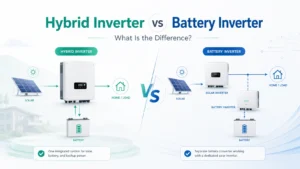
A solar inverter is the “heart” of a photovoltaic power generation system, responsible for converting direct current (DC) from solar panels into alternating current (AC) for household appliances or grid-tie use. Classified by application: centralized inverters for large solar plants, string inverters for commercial rooftops, and micro-inverters for residential setups (optimizing output per panel). Advanced models feature MPPT (Maximum Power Point Tracking) technology to maximize energy harvest, critical for pairing with solar-plus-storage systems.
Net Metering & Feed-in Tariff (FiT)
Net metering is a grid-connection policy allowing users to offset electricity costs by selling excess PV generation back to the grid, measured via bi-directional meters. Complementary to this, Feed-in Tariff (FiT) guarantees fixed payments for solar electricity fed into the grid, driving early adoption. Both mechanisms boost the economics of distributed photovoltaic (DPV) systems, especially when combined with home energy storage to reduce reliance on grid power during peak hours.
Core Terminology in Energy Storage
Energy Storage System (ESS)
An Energy Storage System stores electrical energy for on-demand release, consisting of energy storage batteries, a Battery Management System (BMS), PCS (Power Conversion System), and control units. Classified by technology:
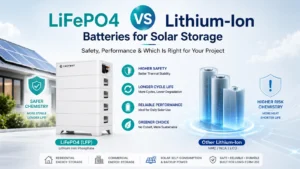
Electrochemical energy storage: Dominated by lithium-ion batteries (e.g., NCM, LFP) and lead-acid batteries, ideal for grid frequency regulation and distributed applications.
Mechanical energy storage: Includes pumped hydro storage (large-scale) and compressed air energy storage (CAES).
Electromagnetic energy storage: Such as supercapacitors for short-duration, high-power needs.
ESS is categorized by application: utility-scale storage (grid-side), commercial & industrial (C&I) storage, and residential energy storage (home battery storage)—with the latter booming globally via “solar + home storage” packages.
Battery Management System (BMS)
The Battery Management System acts as the “brain” of battery packs, monitoring cell voltage, current, temperature, and State of Charge (SOC) in real time. Key functions include preventing overcharge/over-discharge, balancing cell performance, and calculating State of Health (SOH)—a critical metric for estimating remaining lifespan. For second-life battery (SLB) systems, advanced BMS must handle inconsistent cell characteristics to ensure safety and efficiency .
Depth of Discharge (DOD) & Cycle Life
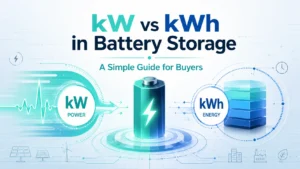
Depth of Discharge refers to the percentage of a battery’s rated capacity discharged during use (e.g., 50% DOD means using half the capacity). Closely linked to cycle life (number of charge-discharge cycles before SOH drops to 80%), it dictates battery economics: shallow DOD (20-30%) extends cycle life but reduces usable capacity. For cascade utilization batteries, targeting 50-60% DOD balances longevity and practicality, especially in stationary energy storage applications.
Key Terminology Related to Power Battery Cascade Utilization
Power Battery Cascade Utilization
Cascade utilization refers to repurposing retired EV batteries (with 70-80% residual capacity) for low-demand scenarios after automotive service . This extends battery value before material recycling, forming a closed-loop lifecycle for lithium-ion batteries (especially lithium iron phosphate (LFP) batteries, the most widely used type in EVs and energy storage). It addresses both resource scarcity and environmental concerns, with global retired EV battery volumes projected to reach 55GWh in 2025 .
Residual Capacity (RC) & Remaining Useful Life (RUL)
Residual Capacity (RC) is the remaining energy capacity of retired batteries, expressed as a percentage of rated capacity— the primary criterion for cascade eligibility. Paired with Remaining Useful Life (RUL) (estimated operational time left), these metrics guide path selection: batteries with >75% RC suit grid storage, while 60-75% RC works for backup power. Measurement requires compliance with standards like GB/T 34015 (vehicle power battery residual energy testing) .
Cascade Grading & Reconditioning
Cascade Grading classifies retired batteries by RC, internal resistance, consistency, and SOH to form homogeneous modules . Post-grading, battery reconditioning (via balancing, capacity restoration, or electrochemical repair) enhances performance: techniques like hydrothermal synthesis or electrochemical lithium replenishment can restore LFP battery capacity by repairing crystal structures . This step is critical for reducing system failure risks.
Second-Life Battery (SLB) & (Cascade Products)
Second-Life Batteries are retired EV batteries reconditioned for secondary use, offering 30-50% cost savings vs. new batteries. Assembled into cascade products (e.g., SLB energy storage containers, backup power units), they serve scenarios like communication base station backup and photovoltaic supporting storage . Mandated by regulations, these products must carry unique traceability codes linked to national management platforms .
Cascade Utilization Paths & Business Models
Common utilization paths align with battery performance:
Grid-scale energy storage: For high-RC batteries, supporting peak shaving & valley filling and renewable integration.
Distributed storage: Paired with rooftop PV for residential/commercial self-consumption.
Backup power: Powering communication towers, data centers, and emergency systems.
Low-speed EVs: Supplying energy for electric bicycles and neighborhood electric vehicles.
Emerging business models include battery leasing and energy-as-a-service (EaaS), which simplify recycling and compliance with producer responsibility extension (EPR) laws .
Battery Recycling & Material Regeneration
After cascade utilization, end-of-life batteries enter recycling—with direct repair regeneration of cathode materials (e.g., LFP) gaining traction. Unlike traditional pyrometallurgy (high energy, pollution), direct regeneration uses hydrothermal or electrochemical methods to restore cathode crystal structures, cutting costs by 40% . This “cascade + regeneration” model is key to sustainable battery supply chains.
Conclusion
Mastering terms like solar + home storage, LFP battery cascade utilization, and BMS SOH monitoring is essential for navigating the solar and energy storage landscape. For power battery cascade utilization, understanding residual capacity grading, SLB system design, and closed-loop recycling enables data-driven path selection—critical as the industry scales. With technologies like AI-powered BMS and direct cathode regeneration advancing, staying updated on terminology ensures alignment with innovation and sustainability goals.