Key Takeaways
- Solar lithium batteries have evolved from expensive backup systems into core infrastructure for modern solar energy projects.
- LFP (Lithium Iron Phosphate) batteries are now the preferred choice for many residential and commercial storage applications because of their safety, long cycle life, and thermal stability.
- Modern battery management systems (BMS) significantly improve reliability, monitoring, and long-term system protection.
- Buyers should evaluate total lifecycle value — not just upfront battery cost.
- Scalable energy storage architecture is becoming essential for future expansion and commercial flexibility.
- Choosing the right supplier matters as much as choosing the right battery chemistry.
The Evolution of Solar Lithium Batteries and What It Means for Energy Storage Projects
Solar lithium batteries have transformed the way homeowners, installers, EPC contractors, and commercial energy users approach energy storage. What was once considered a premium backup solution has now become a practical and scalable part of modern solar infrastructure.
Today, battery storage is no longer only about emergency backup power. It is increasingly used for:
- Solar self-consumption optimization
- Peak shaving and demand charge reduction
- Time-of-use electricity arbitrage
- Energy resilience during outages
- Commercial energy management
- Off-grid and hybrid solar systems
For solar installers and project buyers, the question is no longer whether battery storage is necessary. The real challenge is selecting a system that is safe, scalable, reliable, and financially sustainable over the long term.
This guide explores how solar lithium batteries have evolved, which technologies matter most today, and how buyers can choose the right battery system for residential or commercial energy storage projects.
Choosing a Solar Lithium Battery for Your Next Project?
Share your project requirements with Eway Energy and get practical guidance on battery capacity, system configuration, safety features, and scalable storage options for residential or commercial applications.
Quick Answer: What Is Changing in Solar Lithium Batteries?
Solar lithium batteries are becoming:
| Technology Trend | What It Means for Buyers |
|---|---|
| Safer battery chemistry | Lower thermal runaway risk |
| Longer cycle life | Better long-term ROI |
| Smarter BMS systems | Improved monitoring and protection |
| Modular architecture | Easier future expansion |
| Higher system integration | Faster installation and commissioning |
| Lower manufacturing cost | Better accessibility for residential and commercial users |
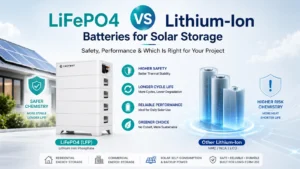
One of the biggest industry shifts is the move toward Lithium Iron Phosphate (LFP) battery technology because of its excellent thermal stability, long service life, and reliable stationary storage performance.
For buyers planning new solar-plus-storage projects, this evolution means lower operational risk, improved lifetime value, and more flexible system design.
If you are comparing different battery chemistries, you may also want to read:
→ “Best Battery Size for a 5kW Solar System” on Eway Energy
From Early Lithium Batteries to Modern Solar Storage
Early lithium battery systems were expensive and primarily designed for consumer electronics and electric vehicles. However, as lithium manufacturing matured, the same advantages that benefited EVs also became highly valuable for solar energy storage:
- Higher energy density
- Faster charging efficiency
- Longer cycle life
- Reduced maintenance
- Better round-trip efficiency
This technological shift allowed solar users to store excess daytime electricity and use it later during the evening or during grid outages, instead of exporting unused energy back to the grid.
For residential users, this improved energy independence.
For commercial users, it opened opportunities for:
- Peak demand reduction
- Backup resilience
- Energy cost optimization
- Grid flexibility
Today, scalable storage architecture is becoming increasingly important for growing energy projects.
For example, Eway Energy Commercial & Industrial ESS Solutions support flexible expansion from small commercial installations to large-scale industrial storage deployments.
Why LFP Batteries Have Become a Practical Choice for Solar Storage
Lithium Iron Phosphate (LFP) batteries have become one of the most widely adopted technologies for stationary energy storage because they combine:
- High thermal stability
- Long operational lifespan
- Reliable daily cycling performance
- Strong safety characteristics
- Lower long-term degradation
Compared with some other lithium chemistries, LFP batteries are particularly suitable for residential and commercial solar systems where long-term reliability matters more than extreme energy density.
Why LFP Matters for Installers and EPC Teams
A solar battery system is not simply a battery pack. It must operate safely and efficiently alongside:
- Hybrid or off-grid inverters
- Solar PV arrays
- Electrical loads
- Monitoring platforms
- Grid interconnection systems
- Local compliance requirements
For this reason, installers increasingly prioritize battery systems with proven LFP chemistry and stable BMS integration.
Explore Scalable Solar Lithium Battery Solutions
From residential backup systems to commercial energy storage projects, Eway Energy provides flexible lithium battery solutions designed for safety, scalability, and long-term performance.
What Buyers Should Evaluate Before Choosing a Solar Lithium Battery
Before selecting a battery storage system, buyers should compare more than just nominal capacity.
Solar Battery Evaluation Checklist
| Evaluation Factor | Why It Matters |
|---|---|
| Battery chemistry | Impacts safety and lifespan |
| Usable capacity | Determines real energy availability |
| Depth of discharge (DoD) | Affects daily usable energy |
| Cycle life | Impacts long-term ROI |
| BMS protection | Prevents abnormal operation |
| Inverter compatibility | Reduces commissioning issues |
| Scalability | Supports future expansion |
| Certifications | Ensures compliance and safety |
| Technical support | Reduces installation risk |
| Warranty structure | Protects long-term investment |
For European projects, buyers should also pay attention to certifications and compliance requirements.
Related reading:
→ Energy Storage Battery Certifications in Europe Guide
Better Battery Management Systems Are Improving Reliability
One of the biggest improvements in modern solar lithium batteries is the development of smarter Battery Management Systems (BMS).
A BMS continuously monitors:
- Voltage
- Current
- Cell balancing
- Charging and discharging
- Temperature
- Fault conditions
- Protection thresholds
Why BMS Technology Matters
A high-quality BMS helps prevent:
- Overcharging
- Over-discharging
- Thermal overload
- Short-circuit conditions
- Abnormal current behavior
For installers and EPC companies, this significantly reduces project risk and improves system reliability.
For end users, it delivers:
- Safer operation
- Better battery lifespan
- More stable long-term performance
- Remote monitoring capability
Modern intelligent storage systems increasingly support:
- Real-time monitoring
- Cloud diagnostics
- Remote firmware updates
- Early fault detection
- Mobile app integration
These features are becoming especially important for commercial and distributed energy storage projects.
Solid-State Batteries and Next-Generation Technologies
Solid-state batteries and next-generation lithium technologies continue to attract attention because they may eventually offer:
- Higher energy density
- Faster charging
- Improved safety
- Lower long-term degradation
However, for most residential and commercial solar projects today, these technologies are still emerging and not yet mainstream.
For practical deployment decisions, buyers usually prioritize:
- Proven reliability
- Stable supply chains
- Real-world safety performance
- Long-term support availability
That is why LFP battery systems continue to dominate the current stationary storage market while the industry monitors future solid-state developments.
How Battery Innovation Changes Solar Project Design
Battery innovation affects much more than technical specifications. It changes how projects are designed, quoted, installed, and maintained.
Key Buyer Concerns and What to Check
| Buyer Concern | What to Check | Why It Matters |
|---|---|---|
| Safety | LFP chemistry, thermal management | Reduces operational risk |
| Lifespan | Cycle life, DoD, warranty | Improves ROI |
| Scalability | Modular design | Supports future expansion |
| Compatibility | Inverter protocols | Simplifies commissioning |
| Application fit | Residential vs commercial | Prevents oversizing |
| Supplier support | Technical service | Improves deployment efficiency |
For commercial users evaluating ROI and system sizing, this guide may also help:
→ Commercial Energy Storage ROI in 2026
Cost Trends Are Making Solar Lithium Batteries More Accessible
As manufacturing scales increase and global battery supply chains mature, solar lithium battery systems are becoming significantly more accessible.
Main Factors Driving Lower Costs
- Improved lithium manufacturing efficiency
- Better cell energy density
- More mature LFP production
- Larger global ESS demand
- Increased inverter-battery integration
- Standardized modular systems
However, buyers should avoid focusing only on initial battery pricing.
Total Lifecycle Value Matters More Than Upfront Cost
A lower-cost battery may not deliver the best long-term project economics if it lacks:
- Strong BMS protection
- Reliable thermal management
- Long cycle life
- Technical support
- Clear warranty coverage
Instead, project buyers should compare total lifecycle value.
Sustainability and Battery Lifecycle Are Becoming More Important
As global energy storage deployment increases, sustainability is becoming a major purchasing consideration.
Buyers increasingly evaluate:
- Battery lifespan
- Replacement frequency
- Recyclability
- Environmental impact
- Material sourcing
- Lifecycle efficiency
Longer-lasting LFP battery systems can help reduce replacement cycles and improve the overall environmental value of a solar storage project.
For commercial and industrial users, this also supports broader ESG and sustainability goals.
The future of solar lithium batteries will not only focus on storing more energy. It will focus on building systems that are:
- Safer
- Easier to maintain
- More intelligent
- More sustainable across the entire lifecycle
How to Choose a Solar Lithium Battery Supplier
Choosing the right supplier is just as important as choosing the right battery technology.
A reliable supplier should help buyers understand:
- System sizing
- Application scenarios
- Inverter compatibility
- Installation requirements
- Warranty structure
- Long-term technical support
Questions to Ask Before Choosing a Supplier
- Does the supplier support both residential and commercial applications?
- Can the system scale as project requirements grow?
- Is pre-sales and after-sales support available?
- Are certifications and technical specifications transparent?
- Does the supplier provide integration guidance?
- Is remote monitoring available?
- Are warranty conditions clearly defined?
For scalable residential and commercial storage systems, you can explore:
→ Eway Energy Home Energy Storage Solutions
→ Eway Energy High Voltage Battery Systems
The Future of Solar Lithium Batteries
The future of solar lithium batteries will be shaped by:
- Safer chemistry
- Smarter BMS systems
- AI-assisted energy management
- Lower manufacturing costs
- Better inverter integration
- Larger commercial adoption
- Utility-scale storage growth
As electricity prices fluctuate and energy resilience becomes increasingly important, battery storage will continue to play a larger role in residential, commercial, and industrial energy systems.
For installers and buyers, the best strategy is to focus on practical long-term value:
- Safe battery chemistry
- Reliable system architecture
- Scalable capacity
- Proven technical support
- Lifecycle economics
Final Takeaway
Solar lithium batteries have evolved from premium backup devices into a foundational part of modern energy infrastructure.
The biggest improvements are not only:
- Higher capacity
- Faster charging
- Lower cost
They are also:
- Better safety
- Longer lifespan
- Smarter monitoring
- Improved scalability
- Stronger lifecycle value
When evaluating a solar battery storage system, buyers should look beyond battery capacity alone and evaluate the complete energy storage ecosystem:
- Battery chemistry
- BMS protection
- Inverter compatibility
- Scalability
- Technical support
- Long-term reliability
The right solar lithium battery system should not simply store energy. It should help the entire solar project operate safely, efficiently, and reliably for many years.
FAQ
What is the best lithium battery type for solar storage?
LFP batteries are widely used in solar energy storage because they provide strong thermal stability, long cycle life, and reliable performance for stationary applications.
Are solar lithium batteries suitable for commercial projects?
Yes. Modern solar lithium battery systems are commonly used for:
- Peak shaving
- Backup power
- Self-consumption
- Demand charge reduction
- Commercial energy optimization
Scalable modular architecture is especially important for commercial projects.
How long do solar lithium batteries last?
Battery lifespan depends on:
- Battery chemistry
- Cycle life
- Depth of discharge
- Operating temperature
- BMS quality
- Charging behavior
A high-quality LFP battery system can typically provide reliable performance for many years under normal operating conditions.
What should installers check before recommending a battery system?
Installers should evaluate:
- Load requirements
- Usable capacity
- Inverter compatibility
- Surge capability
- Safety protections
- Installation environment
- Warranty terms
- Future expansion potential
Can Eway Energy support both residential and commercial storage projects?
Yes. Eway Energy provides scalable residential and commercial energy storage solutions, including low-voltage, high-voltage, and commercial ESS systems for different application scenarios.
Ready to Plan Your Next Solar Battery Project?
Eway Energy helps residential and commercial energy storage buyers choose scalable lithium battery systems based on capacity, safety, application scenario, and project requirements.