A Complete Guide to Choosing the Best Solar Battery (10kWh, 16kWh, 20kWh)
Key Takeaways (2026 – EU & US Market)
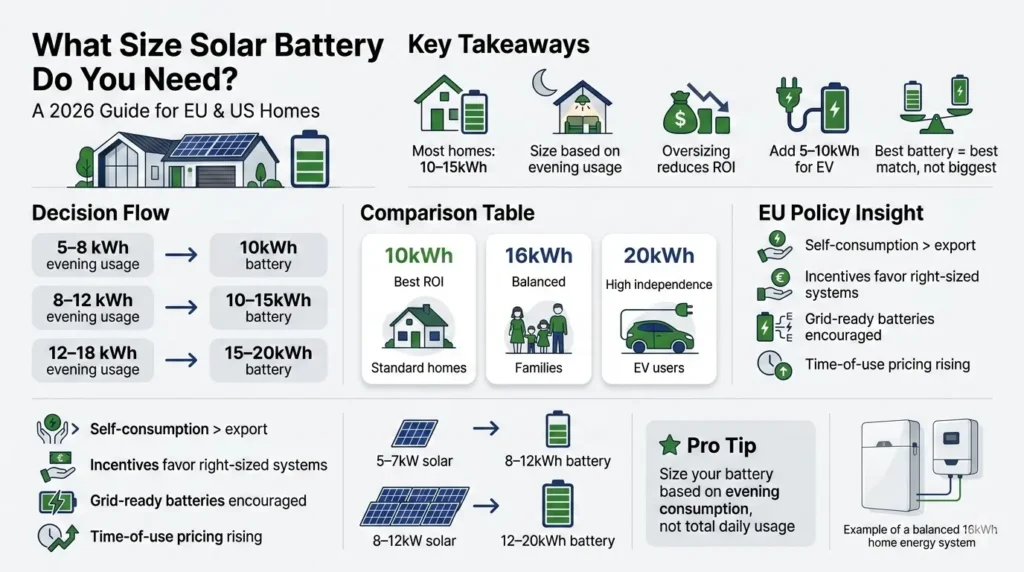
- Most homes need 10–15kWh — the optimal balance between cost, incentives, and usage
- In Europe, incentives increasingly favor right-sized, grid-integrated battery systems
- The best home battery is sized for evening consumption, not total daily use
- 10kWh batteries dominate residential adoption due to ROI efficiency
- 15–20kWh systems are ideal for EV owners or backup-heavy households
- EU policies now prioritize:
- self-consumption
- grid flexibility
- Virtual Power Plant (VPP) readiness
1. Why Battery Sizing Matters in Europe and the US (2026 Context)
In 2026, choosing the best solar battery is no longer just a technical decision — it’s a policy-driven and economics-driven strategy.
Across the EU and US:
- Feed-in tariffs are declining (especially in Germany, Italy)
- Electricity price volatility remains high
- Governments are shifting support toward:
- self-consumption optimization
- grid stabilization
👉 This means:
The best solar powered battery is not the largest one — it’s the one that maximizes usable energy + policy incentives
2. Step-by-Step: How to Size a Solar Battery Correctly
Step 1 — Understand Your Daily Electricity Consumption
| Household Type | Daily Consumption | Suggested Battery |
|---|---|---|
| Apartment | 5–10 kWh | 5–10 kWh |
| Family Home | 10–20 kWh | 10–15 kWh |
| Large / EV | 20–40 kWh | 15–25 kWh |
👉 In Europe, average household consumption ranges between 12–25 kWh/day, depending on electrification levels.
Step 2 — Focus on Evening & Night Usage
When users ask:
👉 “what size solar battery do I need?”
The correct answer depends on:
How much energy you use after solar production stops
Typical European evening loads:
| Household | Evening Usage |
|---|---|
| Small | 4–7 kWh |
| Medium | 7–12 kWh |
| Large / EV | 12–18 kWh |
👉 This is why 10kWh systems are often the best home battery choice
Step 3 — Match Battery Size to Solar Generation
| Solar System Size | Recommended Battery |
|---|---|
| 5–7 kW | 8–12 kWh |
| 8–12 kW | 12–20 kWh |
👉 Oversized batteries without sufficient solar input lead to:
- low utilization
- poor financial return
Step 4 — Always Use “Usable Capacity”
- Nominal ≠ usable capacity
- Most lithium batteries deliver 85–95% usable energy
3. 10kWh vs 16kWh vs 20kWh — Which Is Best?
10kWh Battery (Best ROI for Most Homes)
Best for:
- Typical EU/US households
- Maximizing self-consumption
Why it’s popular:
- Covers evening demand
- Lower upfront cost
- Faster payback
👉 Often considered the best 10kW solar battery price-performance option
16kWh Battery (Balanced & Future-Ready)
For homeowners looking for:
👉 good solar batteries that support flexibility and future expansion
A mid-range system such as
→ Eway Energy UNIV 16kWh Wall-Mounted Battery
fits well because it:
- Supports higher evening demand
- Enables partial backup capability
- Works well with hybrid inverters and smart energy systems
💡 Particularly relevant in Europe where:
- electrification (heat pumps, EVs) is increasing
- energy independence is becoming a priority
20kWh Battery (High Independence Strategy)
Best for:
- EV-heavy households
- backup-focused users
- off-grid or semi-off-grid setups
Trade-offs:
- Higher cost
- Lower marginal return in grid-connected systems
Comparison Table
| Battery Size | Use Case | ROI | Energy Independence |
|---|---|---|---|
| 10kWh | Standard homes | ⭐⭐⭐⭐⭐ | ⭐⭐ |
| 16kWh | Families / hybrid homes | ⭐⭐⭐⭐ | ⭐⭐⭐ |
| 20kWh | Large / EV / backup | ⭐⭐⭐ | ⭐⭐⭐⭐ |
4. 2026 Policy & Incentives (Europe-Focused)
🇪🇺 European Union (RED III & National Incentives)
The Renewable Energy Directive III (RED III) is reshaping battery adoption:
Key policy directions:
- Promote self-consumption over export
- Encourage behind-the-meter storage
- Support energy communities and prosumers
- Require better grid integration and flexibility
🇩🇪 Germany
- KfW programs historically subsidized batteries
- Now shifting toward:
- dynamic tariffs
- smart energy systems
- Batteries increasingly used for:
- self-consumption optimization
- peak shaving
🇮🇹 Italy
- Strong incentives under past “Superbonus” schemes
- Moving toward targeted subsidies + grid participation
🇬🇧 United Kingdom
- No VAT (0%) on solar + battery systems (residential)
- Growth driven by:
- high electricity prices
- time-of-use tariffs
🇺🇸 United States
- Investment Tax Credit (ITC):
- 30% tax credit for batteries (standalone eligible)
- Strong adoption in:
- California (backup + grid support)
- Texas (grid instability)
Key Policy Insight (2026)
Across EU & US:
👉 Incentives increasingly favor:
- right-sized systems
- high utilization
- grid-interactive batteries
Oversizing is no longer economically optimal
5. System Architecture Still Matters (AC vs DC Coupling)
Battery performance depends not only on size, but also on system design.
👉 If you’re evaluating system compatibility, this guide explains the differences clearly:
AC vs DC coupled battery systems — which architecture is right?
https://fujianqichao.musehalo-co.com/ac-coupled-vs-dc-coupled-battery-systems-which-architecture-is-right-for-your-solar-storage/
6. Advanced Factors That Impact Battery Choice
🔹 Time-of-Use Tariffs (Critical in Europe)
Electricity pricing varies significantly:
- Peak hours → expensive
- Off-peak → cheaper
👉 Batteries allow:
- arbitrage (store cheap, use expensive)
🔹 EV Integration
If you own or plan to own an EV:
👉 Add 5–10kWh extra capacity
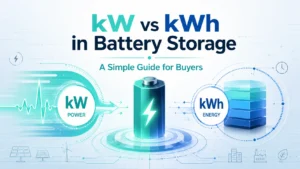
🔹 Power Output (kW vs kWh)
Many users focus only on storage (kWh), but power matters too.
👉 A hybrid inverter like
→ Eway Energy UNIV7600HP
helps ensure:
- stable output for high loads
- efficient energy conversion
- compatibility with modern energy systems
7. Common Mistakes to Avoid
❌ Oversizing the battery
→ leads to underutilization
❌ Ignoring policy incentives
→ reduces ROI significantly
❌ Not matching solar production
→ battery remains partially unused
8. Simple Battery Sizing Formula
Battery Size (kWh) =
Evening Consumption ÷ Efficiency
Example:
- Evening use = 10 kWh
- Efficiency = 90%
👉 Recommended battery ≈ 11–12 kWh
9. Final Recommendation (EU & US Strategy)
- 👉 Best solar battery for most homes: 10–14kWh
- 👉 Best home battery for flexibility: 14–18kWh
- 👉 Best solar powered battery for independence: 18–25kWh
Further Reading
To better understand how to match your energy usage with the right battery size, this guide provides a detailed breakdown:
👉 https://fujianqichao.musehalo-co.com/how-to-match-your-energy-requirements-with-the-right-lithium-ion-solar-battery/
Conclusion
Choosing the best solar battery in 2026 means balancing:
- real energy usage
- system design
- policy incentives
- future energy needs
👉 The most effective systems are:
- properly sized
- highly utilized
- ready for grid interaction
In today’s energy landscape, the best battery is not the biggest —
it’s the one that works intelligently within your energy ecosystem
Ready to Future-Proof Your Energy Storage for 2026?
Choosing the right battery size is only the first step. For European installers and distributors, the real challenge is securing reliable stock with fast, local support.
At Eway Energy, we eliminate the wait. With our strategic warehouses in Poland and France, we provide:
- Local EU Stock: No more 2-month shipping delays from Asia.
- Rapid Delivery: 3-7 day shipping directly to Italy, Germany, and across Europe.
- Zero Customs Stress: Pre-cleared goods mean no hidden duties or complex paperwork.
- Expert Support: Local technical assistance and a 10-year warranty for total peace of mind.
Don’t let logistics hold your 2026 projects back. > Get a Personalized Quote & Check Local Availability Leave a message below, and our European team will get back to you with wholesale pricing and shipping costs within 24 hours.