Key Takeaways
DC-coupled battery storage is typically more efficient because it avoids unnecessary AC/DC conversions.
AC-coupled batteries are ideal for retrofitting into existing solar PV systems without replacing the inverter.
New solar + storage installations usually benefit from DC (hybrid) architecture for cost and performance.
AC systems offer flexibility and redundancy, while DC systems offer streamlined energy flow.
Your choice depends on installation scenario, efficiency goals, budget, and system expansion plans.
I. Introduction — Why Coupling Architecture Matters in Solar Storage
As residential and small commercial solar adoption accelerates, more system owners are adding batteries to capture excess generation, improve self-consumption, and secure backup power.
But once you decide to add storage, a crucial architectural question appears:
Should your battery be AC-coupled or DC-coupled?
This is not just a wiring preference. It directly affects:
System efficiency
Installation cost
Retrofit feasibility
Future scalability
Overall reliability
Understanding the difference between AC coupled battery systems and DC coupled battery storage helps you design a system that matches your energy priorities today and tomorrow.
II. DC-Coupled Battery Systems (The “Hybrid” Approach)
How It Works
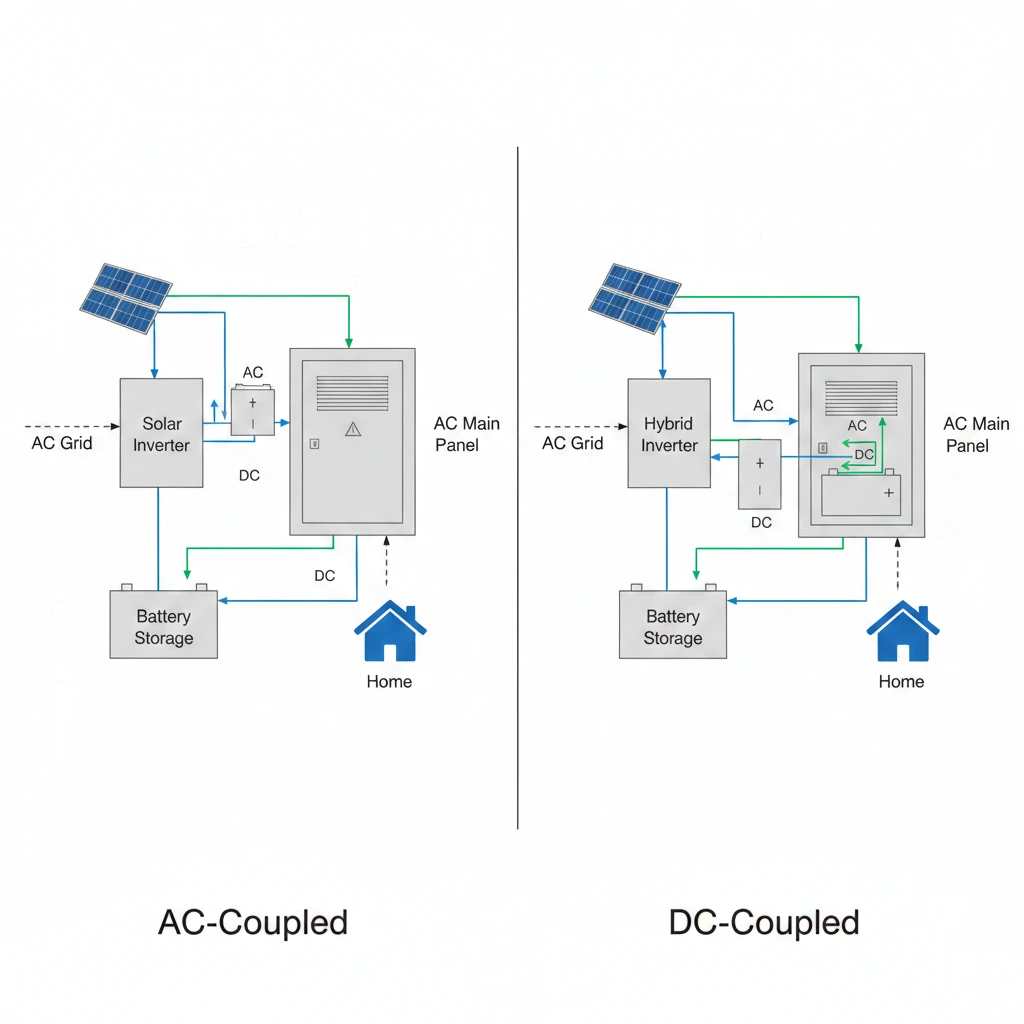
Solar panels naturally produce DC power. In a DC-coupled design, this DC power flows directly into the battery through a hybrid inverter or charge controller, without first being converted into AC.
The Energy Path
| Stage | Energy Flow |
|---|---|
| Solar Panels | DC power generated |
| Hybrid Inverter / MPPT Controller | Direct DC charging of battery |
| Battery | Stores DC energy |
| Inverter | Converts DC → AC for home/grid |
Flow:
Solar (DC) → Hybrid Inverter → Battery (DC) → Inverter → Home/Grid (AC)
Key Advantages
✅ Higher Efficiency
Only one DC→AC conversion occurs when power is used in the home. Fewer conversions = less energy loss.
✅ Lower Cost for New Installations
A single hybrid inverter manages both PV and battery, reducing hardware needs.
✅ Easier Solar Oversizing
You can oversize the PV array beyond inverter AC limits to maximize battery charging.
Main Disadvantages
❌ Difficult to Retrofit
Adding a DC battery to an existing system usually requires replacing the current solar inverter.
❌ Integrated System Complexity
Solar and battery are tightly linked; installation and troubleshooting can be more complex.
III. AC-Coupled Battery Systems (The “Add-On” Approach)
How It Works
Here, solar panels feed a solar inverter first, converting DC into AC for the home. A separate battery inverter/charger then converts AC back into DC to charge the battery.
The Energy Path
| Stage | Energy Flow |
|---|---|
| Solar Panels | DC generated |
| Solar Inverter | DC → AC |
| Switchboard | AC distribution |
| Battery Inverter | AC → DC charging |
| Battery | Stores DC energy |
Flow:
Solar (DC) → Solar Inverter → AC Bus → Battery Inverter → Battery (DC)
Key Advantages
✅ Perfect for Retrofitting
You can add an AC coupled solar battery to nearly any existing PV system without altering it.
✅ Flexibility & Scalability
Solar and battery operate independently. If one fails, the other may still function.
✅ Placement Versatility
Battery units can be located far from the solar inverter.
Main Disadvantages
❌ Lower Efficiency
Multiple conversions:
DC → AC → DC → AC
This results in 1–3% more energy loss than DC systems.
❌ Higher Cost in New Installs
Requires two inverters instead of one.
IV. AC Battery vs DC Battery — Key Comparison Factors
Efficiency Comparison
| System Type | Number of Conversions | Typical Round-Trip Efficiency |
|---|---|---|
| DC Coupled Battery Storage | 1 conversion | 94–98% |
| AC Coupled Battery | 3 conversions | 90–95% |
Conversion losses directly affect how much of your solar energy actually gets stored and reused. This becomes critical when analyzing battery State of Charge (SOC) behavior in real systems. For a deeper technical explanation, see this guide on State of Charge in lithium batteries.
Installation Scenario
| Scenario | Recommended Architecture | Why |
|---|---|---|
| Brand new solar + battery | DC coupled | Lower cost, higher efficiency |
| Adding battery to existing PV | AC coupled | No inverter replacement |
| Off-grid system | DC coupled | Maximum energy retention |
| Backup-focused retrofit | AC coupled | Flexible integration |
System Reliability
AC systems = redundancy (two independent inverters)
DC systems = streamlined but single point of failure (hybrid inverter)
Cost Perspective
| Factor | DC Coupled | AC Coupled |
|---|---|---|
| Inverter cost | Lower (one unit) | Higher (two units) |
| Installation labor | Slightly higher | Lower for retrofit |
| Long-term energy savings | Higher | Moderate |
V. Technical Terminology Explained
| Term | Role |
|---|---|
| Hybrid Inverter | Manages PV and battery in DC-coupled systems |
| Battery Inverter/Charger | Converts AC↔DC in AC-coupled systems |
| Round-Trip Efficiency | % of energy retained after charge/discharge |
| MPPT Controller | Maximizes solar harvest in DC systems |
Understanding these components is especially important when comparing residential vs. commercial storage strategies, as explained here:
C&I vs Residential Energy Storage Systems.
VI. Practical Decision Guide
Choose DC-Coupled Battery Storage If You:
Are installing a new solar + storage system
Want maximum efficiency
Plan for off-grid or high self-consumption
Prefer a streamlined architecture
Choose AC-Coupled Battery If You:
Already have solar installed
Want a simple battery add-on
Need flexible placement
Value system redundancy
Summary Table — AC vs DC Coupling
| Feature | DC Coupled Battery | AC Coupled Battery |
|---|---|---|
| Best for | New installations | Retrofits |
| Efficiency | ⭐⭐⭐⭐⭐ | ⭐⭐⭐⭐ |
| Hardware cost | Lower | Higher |
| Installation complexity | Higher | Lower |
| Scalability | Moderate | High |
| Redundancy | Low | High |
| Off-grid suitability | Excellent | Good |
Where This Fits in Real Battery Product Selection
Modern lithium battery systems and hybrid inverters are increasingly designed to support both AC and DC coupling scenarios, allowing installers to choose the right architecture for each project. When evaluating options, reviewing practical system configurations alongside product specifications—such as those found across residential and commercial battery solutions—can help clarify compatibility and performance expectations.
You can explore example system-ready battery configurations here:
https://fujianqichao.musehalo-co.com/product/
Conclusion
The ac battery vs dc battery debate is not about which is universally better. It is about which is better for your situation.
DC-coupled wins on efficiency and is ideal for new systems.
AC-coupled wins on flexibility and is ideal for upgrades.
Understanding this distinction ensures that your solar storage system is not only functional—but architecturally optimized for long-term performance.