Modern farms are becoming more energy-intensive than ever. Irrigation pumps, greenhouse lighting, cold storage, dairy equipment, poultry ventilation, food processing lines, and farm monitoring systems all depend on stable electricity. At the same time, many farms face rising electricity prices, weak rural grid infrastructure, solar power curtailment, and higher pressure to reduce diesel generator use.
This is why battery farm energy storage is becoming an important part of modern agricultural infrastructure.
A farm battery storage system helps farms store electricity from solar panels, wind power, the grid, or backup generators and use it when power is expensive, unavailable, or unstable. For solar farms and agricultural sites, battery energy storage can improve energy independence, reduce operating costs, protect critical loads, and support long-term sustainable farming.
For installers, EPC contractors, distributors, and project buyers, choosing the right system is not only about battery capacity. It also requires matching the farm load profile, solar PV system, inverter, safety certification, installation environment, and future expansion needs.
EASYWAY provides scalable LiFePO4 solar battery storage and commercial and industrial energy storage systems for agricultural, solar, and C&I energy storage projects.
What Is a Battery Farm?
A battery farm can refer to a large battery energy storage site, but in the agricultural energy context, it usually means a farm using battery storage to manage electricity for daily operations.
A battery farm energy system may include:
- Solar panels
- LiFePO4 battery packs
- Hybrid inverter or PCS
- Battery management system
- Energy management system
- Grid connection
- Diesel generator backup
- Farm loads such as pumps, cold rooms, lighting, ventilation, and processing equipment
In simple terms, a battery farm stores electricity when it is available or cheaper, then releases it when the farm needs power.
For example, a solar farm battery storage system can store excess solar energy generated during the day and discharge it in the evening to power irrigation, cold storage, lighting, or greenhouse climate control.
What Are Battery Farms Used for in Renewable Energy?
In renewable energy projects, battery farms renewable energy systems are used to solve one major problem: solar and wind power do not always generate electricity at the same time users need it.
Solar power is strongest during the day, but many farms need electricity in the early morning, evening, or overnight. Wind generation can also fluctuate. A battery energy storage system helps balance this mismatch.
Battery farms can support renewable energy by:
- Storing excess solar power
- Reducing solar curtailment
- Supplying electricity during peak tariff periods
- Providing backup power during outages
- Stabilizing farm microgrids
- Reducing diesel generator runtime
- Supporting off-grid or weak-grid agricultural sites
For solar-heavy agricultural projects, EASYWAY’s high voltage battery system and C&I battery energy storage system can be used to build scalable solar-plus-storage configurations.
Why Farms Need Battery Energy Storage Systems
Farms do not use electricity in the same way as residential homes. Agricultural loads are often seasonal, high-power, and time-sensitive. A short power interruption can affect production, animal welfare, crop quality, or cold chain safety.
1. Farms Have High and Fluctuating Power Demand
Common farm loads include:
- Irrigation pumps
- Water wells
- Greenhouse LED grow lights
- Ventilation fans
- Heating and cooling systems
- Milk cooling tanks
- Poultry house climate control
- Cold storage rooms
- Packaging and processing machines
- Security and monitoring systems
These loads may create high peak demand during specific hours. A farm battery storage system can discharge during peak periods to reduce the maximum power drawn from the grid.
This is especially valuable for farms with time-of-use tariffs or demand charges.
2. Rural Grids Are Often Limited
Many agricultural sites are located far from strong grid infrastructure. Farms may face:
- Unstable voltage
- Limited grid capacity
- Frequent outages
- Expensive grid upgrades
- Delays in connection approval
- Restrictions on solar export
Battery storage helps farms use more locally generated solar power and reduce pressure on the grid.
For small farm buildings, remote irrigation systems, and rural backup power projects, low voltage solar battery systems can provide a flexible entry-level solution. For larger agricultural sites, commercial solar battery storage is more suitable.
3. Solar Power Alone Is Not Enough
Many farms have large rooftops, open land, barns, greenhouses, and sheds that are suitable for solar PV installation. However, solar generation does not always match the farm’s operating schedule.
Typical problems include:
- Solar generation is high at noon, but farm loads peak later
- Greenhouses may need lighting after sunset
- Cold storage runs continuously
- Irrigation may operate early morning or evening
- Grid export may be limited
- Excess solar power may be wasted
A battery storage system for solar farms stores excess solar energy and makes it available when farm operations need it.
This improves solar self-consumption and can make the solar investment more valuable.
4. Outages Can Cause Direct Agricultural Losses
Power outages on farms are not just inconvenient. They can create real business risk.
Examples include:
- Milk cooling failure in dairy farms
- Poultry ventilation shutdown
- Greenhouse climate control interruption
- Cold storage temperature rise
- Fish farm oxygen pump failure
- Irrigation system downtime
- Automatic feeding system interruption
Battery backup can protect critical loads and reduce the risk of production loss.
For farms where refrigeration, ventilation, or climate control is essential, EASYWAY’s C&I energy storage systems are better suited than small residential batteries because they support higher power output and larger usable capacity.
Solar Farm Battery Storage: How It Works
A solar farm battery storage system usually works in four steps:
- Solar panels generate electricity during the day.
- Farm loads use part of the solar power directly.
- Excess electricity charges the battery.
- The battery discharges during peak tariff hours, cloudy periods, or outages.
A well-designed system may also combine grid power and diesel generator backup.
For example:
A greenhouse uses solar power during the day for irrigation and ventilation. Excess solar power charges the battery. In the evening, the battery powers LED grow lights and climate control, reducing electricity costs during peak tariff hours.
This type of solar-plus-storage setup is especially suitable for:
- Greenhouses
- Irrigation farms
- Dairy farms
- Poultry farms
- Cold storage sites
- Agricultural processing facilities
- Remote farms
- Farm microgrids
Key Benefits of Battery Storage Systems for Farms
Lower Electricity Costs
Farm battery storage can reduce energy costs through:
- Peak shaving
- Time-of-use optimization
- Solar self-consumption
- Reduced grid purchases
- Lower diesel generator use
- Avoided grid upgrade costs
For farms with high daytime solar generation and evening loads, battery storage can significantly improve the value of solar energy.
Backup Power for Critical Loads
Not every farm load needs backup power. The key is to protect the most important systems first.
Critical farm loads may include:
- Cold rooms
- Milk cooling tanks
- Ventilation systems
- Irrigation pumps
- Water supply
- Fish farm oxygen pumps
- Security systems
- Communication equipment
- Farm control systems
A properly sized battery system can prioritize these loads during outages.
Better Use of Renewable Energy
Battery farms renewable energy systems allow farms to use more of their own solar or wind power instead of exporting or wasting it.
This is especially important when:
- Export tariffs are low
- Grid export is restricted
- Solar generation exceeds daytime demand
- The farm wants to reduce diesel or grid dependence
- The site needs off-grid or hybrid power
For projects with larger renewable energy capacity, EASYWAY’s high voltage battery systems and C&I ESS cabinet solutions can support scalable energy storage design.
Reduced Diesel Generator Runtime
Many remote farms still rely on diesel generators. Diesel backup is useful, but it has disadvantages:
- High fuel cost
- Noise
- Emissions
- Maintenance
- Fuel logistics
- Poor efficiency at low load
Battery storage can work with diesel generators to reduce runtime. Instead of running the generator continuously, the system can use solar and battery power for daily loads and keep the generator as backup.
This hybrid structure is often more efficient than diesel-only operation.
Support for Farm Expansion
Battery storage can also help farms expand when the local grid cannot easily support new loads.
Examples include:
- Adding a cold storage room
- Expanding greenhouse lighting
- Increasing irrigation capacity
- Adding packaging equipment
- Building a food processing line
- Installing EV chargers or electric farm machinery charging points
A battery system can act as an energy buffer and reduce peak grid demand.
Planning a Solar Battery Storage Project?
If you are comparing battery types, system voltage, capacity, or inverter compatibility, EASYWAY can help you evaluate a suitable lithium battery solution for your project.
Common Farm Applications for Battery Energy Storage
1. Battery Storage for Irrigation
Irrigation pumps can create high power demand, especially during dry seasons. Solar energy often matches irrigation needs well, but battery storage allows farms to operate pumps outside peak sunlight hours.
Recommended system types:
- Small irrigation site: low voltage LiFePO4 battery
- Medium irrigation project: high voltage battery system
- Large solar irrigation farm: commercial and industrial energy storage system
2. Battery Backup for Dairy Farms
Dairy farms need stable electricity for:
- Milking machines
- Milk cooling tanks
- Ventilation
- Feeding systems
- Cleaning systems
- Water pumps
If power fails, milk quality and production routines may be affected.
For dairy operations with larger cooling and mechanical loads, a C&I battery energy storage system can provide backup power and peak shaving in one solution.
3. Energy Storage for Greenhouses
Greenhouses are one of the strongest use cases for farm battery storage because they often have high and continuous electricity demand.
Common loads include:
- LED grow lights
- Heating
- Cooling
- Ventilation
- Humidity control
- Irrigation
- Sensors
- Automation systems
Battery storage helps greenhouses reduce peak electricity costs, use more solar power, and protect climate control systems during outages.
For medium-sized greenhouse projects, a high voltage solar battery system may be suitable. For large greenhouse parks, EASYWAY’s C&I ESS solutions are a better fit.
4. Poultry Farm Battery Storage
Poultry farms depend heavily on ventilation, lighting, heating, cooling, and feeding equipment. A power failure can quickly affect animal welfare.
Battery storage can support:
- Emergency ventilation
- Lighting schedules
- Climate control
- Feeding systems
- Alarm and monitoring systems
For poultry farms, the backup system should be designed around critical load priority rather than total site load.
5. Cold Storage and Agricultural Processing
Cold storage is one of the most important applications for battery farms. Fruit, vegetables, meat, dairy products, and seafood can lose value if temperature control fails.
Battery storage supports:
- Refrigeration backup
- Peak shaving
- Power quality stabilization
- Solar self-consumption
- Reduced outage risk
For cold rooms and processing facilities, EASYWAY’s 112kWh to 261kWh C&I energy storage systems can be used for centralized energy management.
6. Off-Grid and Remote Farms
Remote farms may not have reliable grid access. In these cases, a hybrid system can combine:
- Solar PV
- Battery storage
- Diesel generator
- Hybrid inverter
- Energy management system
Battery storage reduces generator runtime and improves power availability.
For off-grid agricultural projects, system sizing should consider seasonal weather, daily load demand, battery autonomy, and backup generator strategy.
How to Choose the Right Farm Battery Storage System
Choosing a farm battery system should start with the load profile, not just the battery price.
Step 1: Identify Critical Loads
List the equipment that must keep running during outages.
Examples:
| Load | Why It Matters |
|---|---|
| Cold storage | Prevents product loss |
| Ventilation | Protects animals |
| Irrigation pump | Maintains crop water supply |
| Milk cooling tank | Protects dairy quality |
| Greenhouse control | Maintains crop environment |
| Oxygen pump | Protects aquaculture stock |
Step 2: Calculate Daily Energy Consumption
Use this simple formula:
Daily energy consumption = Power × Operating hours
Example:
| Equipment | Power | Hours per Day | Daily Energy |
|---|---|---|---|
| Irrigation pump | 15kW | 4h | 60kWh |
| Cold storage | 8kW | 10h | 80kWh |
| Ventilation | 5kW | 12h | 60kWh |
| Lighting | 6kW | 6h | 36kWh |
| Total | – | – | 236kWh |
This farm may need a system in the 200kWh+ range if the goal is backup and daily energy optimization.
Step 3: Match kWh and kW
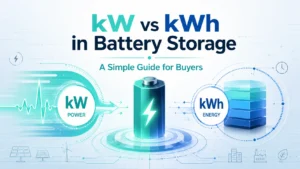
Battery sizing has two important values:
- kWh means how much energy the battery can store.
- kW means how much power the system can output at one time.
A farm with many motors, pumps, compressors, or refrigeration loads must pay close attention to power output, not only battery capacity.
Step 4: Choose the Right Product Type
| Farm Project Type | Suggested EASYWAY Product Direction |
|---|---|
| Small farm house or shed | Low voltage battery |
| Small solar irrigation project | Low voltage solar battery or high voltage battery system |
| Greenhouse or dairy farm | High voltage battery system |
| Cold storage or poultry farm | C&I battery energy storage system |
| Agricultural processing facility | Commercial and industrial energy storage system |
| Large farm microgrid | Scalable C&I ESS solution |
| European farm installer projects | EU energy storage solution |
EASYWAY Battery Storage Solutions for Farm Projects
Different farms need different battery configurations. A small rural property does not need the same system as a greenhouse, cold storage warehouse, or agricultural processing center.
Low Voltage Batteries for Small Farm Loads
EASYWAY’s low voltage battery systems are suitable for:
- Farm houses
- Small sheds
- Rural backup power
- Small solar systems
- Security and communication loads
- Small irrigation applications
- Light commercial farm buildings
These systems are easier to deploy for smaller projects and can be used by installers who need flexible solar battery options.
High Voltage Batteries for Medium Farm Energy Storage
For medium-sized farms, greenhouses, and solar-plus-storage projects, EASYWAY’s high voltage battery systems provide higher efficiency and modular expansion.
They are suitable for:
- Greenhouse lighting
- Farm building solar storage
- Dairy farm backup power
- Larger irrigation systems
- Rural commercial energy storage
- Installer-led solar battery projects
High voltage systems are especially useful when the farm needs more output power and better system efficiency than a basic low voltage battery setup.
C&I ESS for Large Farms, Greenhouses, and Cold Storage
For larger agricultural sites, EASYWAY’s commercial and industrial energy storage systems are the most suitable option.
They can support:
- Peak shaving
- Solar self-consumption
- Backup power
- Load shifting
- Farm microgrids
- Cold storage backup
- Agricultural processing
- Greenhouse energy management
- Diesel generator hybrid systems
EASYWAY’s C&I ESS product range includes cabinet-level solutions such as 112kWh, 233kWh, 241kWh, and 261kWh systems, which can be used for medium to large agricultural energy storage projects.
EU Farm Energy Storage Projects: What Buyers Should Consider
For European farm energy storage projects, compliance and delivery reliability are especially important.
Installers, distributors, and EPC contractors often need:
- EU-ready documentation
- CE, EMC, RED, UN38.3, and MSDS support
- Inverter compatibility
- Low MOQ for market testing
- OEM/ODM options
- Local stock or faster delivery
- Product support for residential, commercial, and agricultural projects
EASYWAY’s EU energy storage solution is designed for European installers, distributors, and project buyers who need scalable LiFePO4 battery systems for residential, commercial, and agricultural energy storage applications.
This page is especially relevant for buyers working on:
- Farm solar battery projects
- Greenhouse storage systems
- Rural backup power
- Agricultural C&I energy storage
- EU solar installer distribution
- Commercial farm energy solutions
Battery Storage System for Solar Farms vs Farm Energy Storage
The keyword battery storage system for solar farms usually refers to utility-scale or commercial solar sites that use batteries to store renewable energy. Farm energy storage can overlap with this, but the focus is slightly different.
A solar farm battery storage project mainly focuses on:
- Grid export
- Renewable energy shifting
- Energy trading
- Solar curtailment reduction
- Grid services
A farm battery storage project mainly focuses on:
- Irrigation
- Cold storage
- Backup power
- Greenhouse loads
- Dairy or poultry operation
- Processing equipment
- Reducing farm electricity bills
Some agricultural projects need both. For example, a large farm with solar PV, cold storage, irrigation pumps, and grid export limitations may need a battery system that supports both renewable energy storage and farm load management.
Battery Farming: What Does It Mean?
The term battery farming can be confusing. In agriculture, “battery farming” historically refers to intensive animal farming systems, especially cage-based poultry production. However, in the renewable energy and storage industry, users may search for battery farming when they mean battery farms or battery storage for farms.
In this article, battery farming refers to the use of battery energy storage systems in agricultural and renewable energy projects.
For agricultural businesses, this means using battery storage to improve energy resilience, reduce electricity costs, and make better use of solar power.
What Provides Long-Term Energy Storage for Plants and Animals?
Some users searching for farm energy storage also ask biology-related questions such as:
- what provides long term energy storage for plants
- what provides long term energy storage for animals
- what provides short term energy storage for animals
These questions usually refer to biological energy storage, not battery systems.
In biology:
- Plants mainly store long-term energy as starch.
- Animals mainly store long-term energy as fat.
- Animals use glycogen for shorter-term energy storage.
In agricultural energy systems, however, long-term electrical energy storage is provided by battery systems, hybrid renewable systems, thermal storage, or fuel-based backup systems.
For farms, LiFePO4 battery storage is commonly used for daily cycling, backup power, and solar energy storage. For very long-duration backup, farms may combine batteries with diesel generators, biogas, or other energy sources.
Farm Battery Storage ROI: What Affects Payback?
The payback period of a farm battery storage system depends on several factors:
- Electricity price
- Peak and off-peak tariff difference
- Demand charges
- Solar PV size
- Battery capacity
- Daily cycling frequency
- Diesel generator savings
- Outage loss prevention
- Installation cost
- Local incentives
- Grid export rules
- Maintenance cost
- System lifespan
Battery storage often delivers the strongest value when a farm has:
- High electricity costs
- Large solar PV generation
- Frequent peak demand
- Critical backup requirements
- Diesel generator dependence
- Cold storage or greenhouse loads
- Weak grid connection
For B2B buyers, the best approach is to calculate ROI based on real electricity bills, load curves, and project objectives.
Common Mistakes When Choosing Farm Battery Storage
Choosing Capacity Without Load Data
A battery system should not be sized only by guessing kWh. Farms should first analyze load power, operating hours, and critical backup needs.
Ignoring Peak Power
Many farm loads use motors or compressors. These may require higher startup power. The PCS or inverter must be sized correctly.
Backing Up Every Load
Trying to back up the entire farm may make the system too expensive. It is often better to separate critical and non-critical loads.
Ignoring Outdoor Conditions
Farm environments can be dusty, humid, hot, cold, or exposed to outdoor conditions. Battery enclosures, thermal management, and IP protection are important.
Not Planning for Expansion
Farms may later add cold storage, electric machinery, more pumps, or larger solar systems. The battery system should allow future expansion where possible.
FAQ About Battery Farm Energy Storage
What are battery farms?
Battery farms are energy storage systems that use large battery banks to store electricity and release it when needed. In agriculture, a battery farm may refer to a farm using battery storage to support solar power, backup power, irrigation, cold storage, or farm operations.
What is solar farm battery storage?
Solar farm battery storage stores electricity generated by solar panels and releases it when solar production is low, electricity prices are high, or the grid needs support. On farms, it can also power irrigation, greenhouses, cold storage, and other agricultural loads.
What is a battery storage system for solar farms?
A battery storage system for solar farms usually includes battery packs, PCS or hybrid inverter, BMS, EMS, protection systems, and grid connection equipment. It stores excess solar energy and improves renewable energy use.
Can battery storage reduce farm electricity bills?
Yes. Battery storage can reduce farm electricity bills through peak shaving, time-of-use optimization, solar self-consumption, diesel reduction, and avoided grid upgrade costs.
What battery type is best for farms?
LiFePO4 batteries are widely used for farm energy storage because they offer strong safety, long cycle life, stable performance, and low maintenance.
Can a farm run off-grid with solar and batteries?
Yes, but the system must be carefully sized. Off-grid farms often need solar panels, battery storage, hybrid inverters, backup generators, and energy management systems.
How much battery storage does a farm need?
It depends on the farm’s daily energy use, peak power demand, backup duration, solar PV size, electricity tariff, and critical loads.
Are battery farms renewable energy systems?
Battery farms are not energy generation systems by themselves, but they support renewable energy by storing solar or wind power and making it available when needed.
Conclusion: Battery Farm Energy Storage Is Becoming Core Infrastructure for Modern Agriculture
Battery farm energy storage is no longer just a backup option. For modern farms, it is becoming a practical infrastructure investment that supports lower electricity costs, better solar energy use, stronger resilience, and more sustainable agricultural operations.
Whether the project is a small solar irrigation system, a greenhouse, a dairy farm, a poultry operation, a cold storage facility, or a large agricultural microgrid, the right battery system should be selected based on real load data, backup needs, solar capacity, and future expansion plans.
EASYWAY supports agricultural and solar energy projects with low voltage battery systems, high voltage battery systems, commercial and industrial energy storage systems, and EU energy storage solutions for installers, distributors, EPCs, and project buyers.
For farm, greenhouse, cold storage, or solar-plus-storage projects, contact EASYWAY to get a suitable battery storage recommendation.
Get a Project-Based Lithium Battery Recommendation
Whether you are planning a home solar battery system, a high-voltage stackable battery solution, or a commercial energy storage project, EASYWAY can help you select a safer and scalable battery configuration.