Optimized for Installers, Distributors & ESS Professionals
As residential, commercial, and microgrid energy storage rapidly expands, one factor determines project performance more than any individual product:
How well the inverter (PCS) and battery system (BMS) work together.
Even a premium inverter or high-end battery cannot deliver stable results without proper communication, coordinated control, and system-level protection.
In other words: synergy is the real performance booster.
1. Why Strong Inverter–Battery Synergy Matters
For installers and distributors, the most common issues—unstable charging, low efficiency, SOC inaccuracy, unexpected shutdowns—almost always stem from poor PCS–BMS coordination.
High-performing systems share three essential capabilities:
✔ Fast, Accurate Real-Time Communication
CAN / CAN FD high-speed data exchange
SOC accuracy within ±3%
Dual-CAN redundancy for reliability
This ensures the inverter always receives correct battery limits and status.
✔ Smart Charge & Discharge Control
BMS sets safe current, temperature, and voltage limits
PCS adjusts MPPT and output in real time
Predictive control smooths power fluctuations and protects battery life
✔ System-Level Safety Protection
Hardware-level emergency shutdown
Over-voltage, over-current, and thermal protections
Compliance with IEC 62619 / UL 1973
This reduces on-site risk and long-term maintenance costs.
2. Battery Technology Trends Installers Should Track
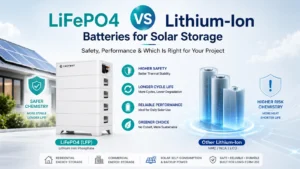
LFP (Lithium Iron Phosphate) Batteries
Now the dominant chemistry for ESS due to:
6,000+ cycles @ 80% DoD
Excellent thermal stability
Strong cost-performance
Silicon–Carbon Anode Batteries
For installers seeking compact, high-density home storage units:
Energy density up to ~300 Wh/kg
Smaller footprint, higher usable capacity
Sodium-Ion Batteries
A cost-efficient solution for C&I and emerging markets:
Abundant raw materials
Good low-temperature performance
When selecting batteries, installers should prioritize:
cycle life → discharge rate → temperature performance → BMS compatibility.
3. Inverter Technology: Efficiency and Intelligence Lead the Future
High-Efficiency PCS (96%–98%+)
SiC and GaN power devices reduce heat and conversion losses, increasing both usable energy and ROI.
AI-Enabled EMS (Energy Management Systems)
Next-generation systems offer:
Higher PV utilization
Peak–valley time arbitrage
Automated backup switching
Remote monitoring & OTA updates
Multi-Protocol Compatibility
Inverters supporting Modbus RTU/TCP, CAN, and common battery protocols significantly reduce on-site debugging time—a major advantage for installers.
4. AC Coupling vs. DC Coupling: A Practical Guide for Installers
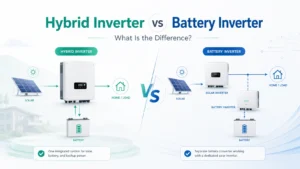
DC Coupling — Best Efficiency (New Projects)
Direct PV-to-battery charging
Higher system efficiency
Lower conversion loss
Best for: new residential ESS, hybrid inverters, new C&I systems.
AC Coupling — Best Flexibility (Retrofits)
Ideal for adding ESS to existing solar installations
Independent inverter operation
Easy expansion
Best for: existing PV owners, multi-inverter systems, C&I retrofits.
Installer decision logic:
Do they already have PV? Are they prioritizing efficiency or flexibility? What is the installation timeline?
5. What This Means for Installers & Distributors
Choosing the right inverter–battery combination determines:
Installation speed & simplicity
Long-term system stability
Customer satisfaction
After-sales workload
Project ROI
Focus on:
✔ Communication stability
✔ Charge/discharge performance
✔ Certification & safety
✔ Compatibility & expansion options
The strongest systems help you:
install faster → reduce service calls → improve customer loyalty → increase repeat business.
6. The Future: Integrated, Intelligent, and Predictive
Energy storage systems are moving toward:
Fully integrated PCS + BMS + EMS
AI forecasting and automated scheduling
Digital twins & predictive maintenance
High-efficiency power electronics
Advanced battery chemistries (solid-state, sodium-ion)
Universal communication protocols
Whether you are a battery manufacturer, inverter brand, installer, or distributor, your competitive edge will depend on:
High compatibility, high reliability, and high intelligence.