Editorial note: This article draws on public incident reports, publicly available international safety standards, and EASYWAY’s published product documentation available at ewayenergy.com.
In July 2026, a battery storage system connected to a rooftop solar installation in Germany experienced a thermal incident. The overheating of a battery module led to a fire, causing property damage and highlighting the importance of advanced battery safety design, thermal management, and protection systems in energy storage applications. Relevant authorities are investigating the exact cause of the incident.(pv magazine, 2026).

Incidents like this are still rare relative to the number of battery energy storage systems(BESS) now installed worldwide. But they’re a useful reminder of something the industry doesn’t talk about enough: a battery’s safety isn’t determined by one factor. It’s the sum of cell chemistry, system-level engineering, certification, and — just as importantly — how and where the system is installed. This article walks through what actually causes battery failures, what the safety standards behind reputable products really test for, and what both homeowners and commercial buyers should look for when choosing a system,whether for a house,a small business,or an industrial facility.
Why Lithium Battery Fires Happen: Understanding Thermal Runaway
Almost every residential and commercial battery storage system on the market today uses some form of lithium-ion chemistry, prized for its energy density, cycle life, and efficiency. The safety risk associated with that chemistry has a name: thermal runaway.
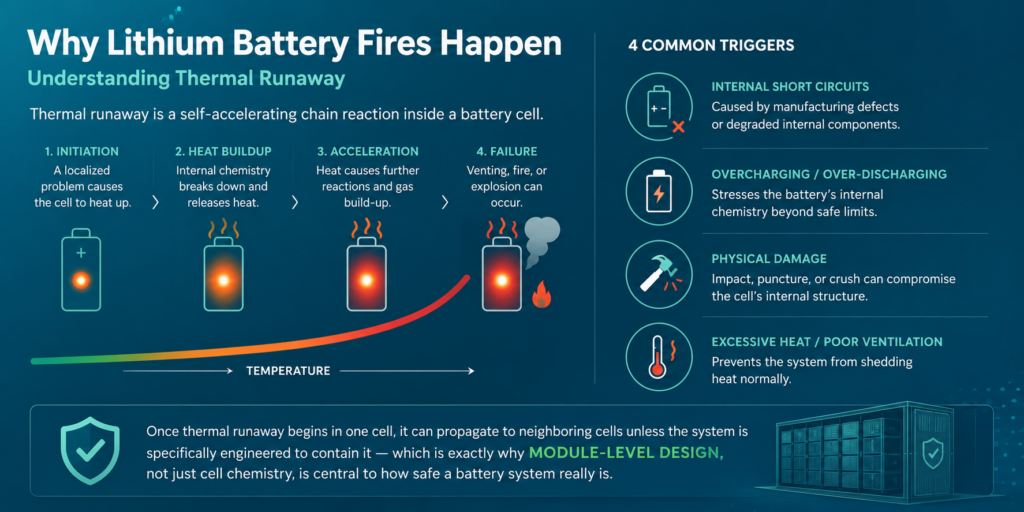
Thermal runaway is a self-accelerating chain reaction inside a battery cell. It typically starts with a localized problem — an internal short circuit, physical damage, overcharging, or exposure to excessive heat — that causes a small area of the cell to heat up. Past a certain threshold, the cell’s internal chemistry begins breaking down and releasing its own heat,faster than it can be dissipated. That heat pushes the reaction further, gases build up inside the sealed cell, and the process can culminate in venting, fire, or, if gases accumulate in an enclosed space, an explosion of the kind reported in Germany.
The four most common triggers cited across the industry are:
·Internal short circuits caused by manufacturing defects or degraded internal components
·Overcharging or over-discharging, which stresses the battery’s internal chemistry beyond safe limits
·Physical damage, such as an impact, puncture, or crush that compromises the cell’s internal structure
·Excessive ambient heat or poor ventilation, which prevents the system from shedding heat normally
Once thermal runaway begins in one cell, it can propagate to neighboring cells unless the system is specifically engineered to contain it — which is exactly why module-level design, not just cell chemistry, is central to how safe a battery system really is.
Not All Lithium Batteries Are Equal: LiFePO4 vs NMC
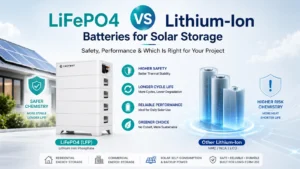
The specific lithium-ion chemistry used in a battery has a major impact on how resistant it is to thermal runaway in the first place. The two chemistries most common in stationary energy storage are Lithium Iron Phosphate (LiFePO4, or LFP) and Nickel Manganese Cobalt (NMC).
LiFePO4 uses a phosphate-based cathode with strong internal chemical bonds, which require significantly more heat energy to break down than the metal-oxide cathodes used in NMC cells. In practical terms, this gives LiFePO4 a meaningfully higher thermal runaway onset temperature and a wider safety margin before instability sets in, which is a major reason it has become the dominant chemistry for residential and light commercial storage over the past several years, even though NMC still offers a slight energy-density advantage that keeps it common in some EV and utility-scale applications. (For a deeper technical comparison,see EASYWAY’s own LFP vs NMC breakdown.)
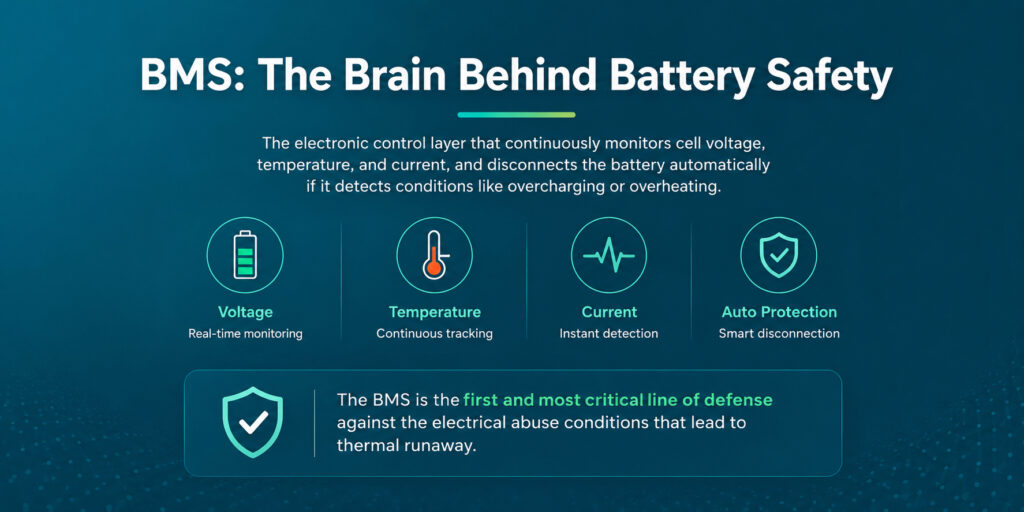
This is also why chemistry alone isn’t a complete safety story: even a stable chemistry needs a well-designed battery management system (BMS) — the electronic control layer that continuously monitors cell voltage, temperature, and current, and disconnects the battery automatically if it detects conditions like overcharging or overheating. The BMS is often described as the first and most critical line of defense against the electrical abuse conditions that lead to thermal runaway in the first place.
The Safety Standards That Actually Matter
Certification badges are everywhere in battery marketing, but most buyers never learn what the standards behind them actually test. Here’s what the major ones cover:
IEC 62619 is the international safety standard for lithium cells and batteries used in industrial and stationary applications, including home and C&I energy storage. It defines electrical, mechanical, thermal, and BMS safety requirements — covering conditions like overcharge, short circuit, and functional safety of the control system — that a battery must pass before it’s considered safe for deployment (IEC, 2022).
UN38.3 governs the transport safety of lithium batteries — the tests a battery pack must pass (altitude simulation, thermal cycling, vibration, shock, and short-circuit testing) before it can be legally shipped.
Where and How You Install Your System Matters as Much as the Battery Itself
This is the gap most safety content skips over, and it’s directly relevant to the Bentwisch incident: the battery involved was installed in a wooden outbuilding on the property, a structure with limited fire resistance and, based on public reporting, no indication of dedicated fire separation from combustible materials.
Installation location and enclosure design are among the most controllable safety variables a homeowner or facility manager has, and they matter regardless of how good the battery itself is:
· Keep distance from combustible structures. Wood-framed sheds, garages, or storage buildings without fire-rated separation increase the risk that a battery failure escalates into a structure fire.
· Ensure adequate ventilation. Poor airflow around a storage unit makes it harder for the system to shed heat under normal operation and worse in a fault condition.
· Use professional installation. A qualified installer will size the system correctly for the space, follow manufacturer clearance requirements, and comply with local fire code — the same codes that standards like NFPA 855 are designed to inform.
· Avoid DIY siting decisions based on convenience alone. A shed or garage may be the easiest place to put a battery, but it isn’t automatically the safest.
For commercial and industrial (C&I) deployments, these considerations scale up significantly — larger systems require formal separation distances, dedicated enclosures or containers, and often site-specific fire protection engineering, which is one reason C&I energy storage projects typically involve much more rigorous permitting and design review than a residential wall-mounted unit.
What Homeowners and Facility Managers Should Watch For
Modern lithium battery systems are engineered with multiple layers of protection, and serious failures remain uncommon. Still, it’s worth knowing the early warning signs and the right response if something does go wrong:
Warning signs: unusual heat coming from the unit, a persistent chemical or burning odor, hissing or popping sounds, visible swelling or deformation of the enclosure, or repeated fault alarms from the BMS.
If you notice any of these: don’t attempt to open or inspect the unit yourself. Isolate power if it’s safe to do so, evacuate the area, and call emergency services — treat it the same way you would treat any serious electrical fault, not a routine appliance issue. Never use water or foam on a battery fire of unconfirmed origin unless directed by fire services, since improper suppression methods can be ineffective or unsafe.
Ongoing maintenance: residential systems benefit from periodic professional inspection, prompt firmware/BMS updates from the manufacturer, and a visual check for physical damage or corrosion — the same principle behind the compliance audits and routine inspections that C&I operators are expected to run on a larger scale.
A Buyer’s Checklist for a Safer Energy Storage System
Whether you’re a homeowner evaluating a home battery or a facility manager specifying a C&I system, the same underlying questions apply:
1.What cell chemistry is used, and what’s its documented thermal runaway threshold?
2. What certifications does the system hold — at the cell level, module level, and system level — and what did each one actually test?
3. How sophisticated is the BMS, and does it provide real-time monitoring with automatic disconnect?
4. What’s the enclosure rating (e.g., IP65 for outdoor/weather resistance), and does the product include a specific fire protection design or built-in containment/suppression mechanism?
5. Does the manufacturer provide installation guidance covering siting, clearance, and ventilation — not just electrical wiring?
6. What’s the warranty and cycle-life rating, which together serve as a reasonable proxy for manufacturing quality control?
7. Is the installer certified and familiar with local fire and electrical code?
How EASYWAY Designs for Safety
EASYWAY builds its residential and C&I energy storage systems around the same principles outlined above — chemistry, certification, enclosure design, and BMS protection working together, not any one of them in isolation.
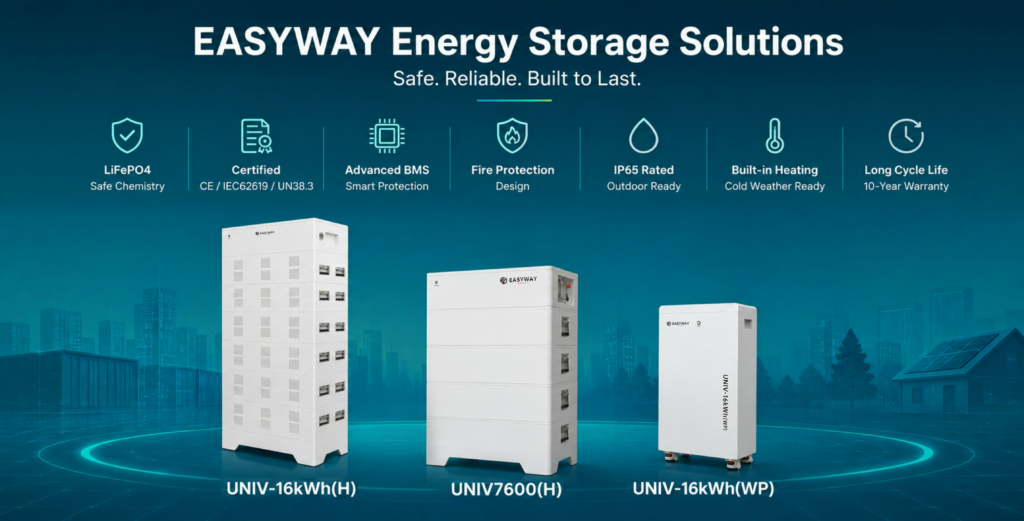
Chemistry. The entire residential range, from the compact UNIV5100 (5.12kWh) through the high-capacity UNIV-16kWh series and the stackable UNIV7600(H) high-voltage platform, is built exclusively on LiFePO4 chemistry, for the thermal-stability reasons explained above.
Certification. Products across the range carry CE certification (LVD, EMC, and RED), IEC62619 at the cell level, and UN38.3 for transport safety, with MSDS documentation available. As noted earlier, IEC 62619 certification itself requires the battery’s control system to pass formal functional safety analysis — meaning BMS behavior under fault conditions is independently evaluated, not just self-declared.
BMS protection. EASYWAY’s high-voltage modular stackable systems, such as the UNIV-16kWh(H), are equipped with a BMS that provides monitoring and protection for voltage, temperature, and current, along with system-level safety management. Each battery pack is also paired with an Intelligent Battery Control Unit (IBCU) for enhanced control and safety performance.EASYWAY also publishes its own explainer on how battery management systems work, covering the same core functions referenced earlier in this article — voltage and temperature monitoring, cell balancing, and automatic thermal protection that triggers an alarm or shutdown if temperatures exceed safe limits.
Enclosure and fire protection design. This varies by product line, so it’s worth being specific rather than generalizing across the whole range:
·The UNIV-16kWh(WP) and the UNIV7600(H) stackable high-voltage platform carry an IP65 rating — a fully dust-tight enclosure with protection against water projected from a nozzle in any direction, a meaningfully higher standard than the IP54 or IP20 ratings still common on indoor-only battery designs — making both suitable for outdoor or semi-outdoor installation without an additional weatherproof housing.
·The UNIV-16kWh(H) high-voltage system is built with a fire-extinguishing mechanism designed to help contain a fault before it escalates, in addition to its modular design supporting up to 15 stacked battery modules (32–241kWh).
·The UNIV-16kWh(WP) wall-mounted low-voltage unit carries its own dedicated fire protection design as part of its enclosure.
Cold-weather operation. Several models include a built-in heating function for low-temperature operation, which helps prevent the kind of cold-weather charging stress that can contribute to cell degradation over time.
Longevity and manufacturing. Cycle-life ratings vary by model — the UNIV-16kWh(WP), for example, is rated above 8,000 cycles — with 10-year warranties across the home battery range. This is backed by more than two decades in the industry and in-house R&D; EASYWAY operates one of the larger lithium battery pack production bases in central China (see our company profile).
Frequently Asked Questions
· Is home battery storage safe?
Yes, for the overwhelming majority of installations. Modern residential systems use multiple layers of protection — cell chemistry, battery management systems, certified enclosures, and installation codes — that together make serious failures rare. Incidents like Bentwisch remain notable specifically because they’re uncommon.
· Is LiFePO4 safer than NMC for home batteries?
LiFePO4 has a meaningfully higher thermal runaway onset temperature than NMC, giving it a wider safety margin, which is why it has become the dominant chemistry for residential and light commercial storage. NMC retains a slight energy-density edge that keeps it in use for some EV and utility-scale applications.
· Where should a home battery be installed?
Away from combustible structures where possible, with adequate ventilation, installed by a qualified professional who follows manufacturer clearance requirements and local fire code. Siting is one of the most controllable safety factors a homeowner has, independent of the battery itself.
· What’s different about safety requirements for C&I energy storage?
C&I systems are larger and typically require formal separation distances, dedicated enclosures or containers, and site-specific fire protection engineering, with more rigorous permitting and design review than a single residential wall-mounted unit.
The Bottom Line
Battery storage is safer today than it has ever been, and the data on residential and C&I adoption shows the industry is only getting bigger. The systems that stay safe as that growth continues will be the ones built on real engineering discipline, not just a certification logo — chemistry, system design, third-party testing, and correct installation working together, not any single one in isolation.
Working with EASYWAY on a residential or C&I energy storage project? Get in touch to discuss battery configuration, certification documentation, and inverter compatibility for your market.
Get a Project-Based Lithium Battery Recommendation
Whether you are planning a home solar battery system, a high-voltage stackable battery solution, or a commercial energy storage project, EASYWAY can help you select a safer and scalable battery configuration.