If you’re an installer or distributor in the UK residential energy market, the next 18 months represent the most favourable policy environment for home battery sales since the original solar feed-in tariffs. Several incentive programmes are stacking on top of each other, a VAT relief is on a countdown clock, and a building regulation change is about to push solar-ready housing stock into the market at scale.
Most of the policy guidance available online is written for homeowners. That’s useful, but it doesn’t answer the questions that actually matter for your business: which incentives should your sales team be leading with, how should this reshape your stocking strategy, what paperwork risk are you taking on with grant-funded installs, and where is the addressable market actually growing.
This guide answers those questions directly.
What you’ll learn:
- Why the 2026-2027 window is a genuine demand-acceleration event, not just background policy noise
- How to map the incentive landscape into a sales conversation your reps can actually use
- The retrofit battery opportunity hiding in your existing solar customer base
- A stocking and bundling framework based on a simple inverter-to-battery sizing ratio
- What grant-funded installs require from you on paperwork and specification compliance
- Real quote comparisons you can adapt for proposals
Planning a Solar Battery Storage Project?
If you are comparing battery types, system voltage, capacity, or inverter compatibility, EASYWAY can help you evaluate a suitable lithium battery solution for your project.
Why This Window Matters for Your Business
Policy windows create demand spikes. The question for installers and distributors isn’t whether the spike will happen — it’s whether your sales pipeline, stock levels, and installer capacity are positioned to capture it before it closes or before your competitors do.
The VAT countdown is a closing argument, not just a discount
The 0% VAT rate on home battery storage and residential solar runs until 31 March 2027. After that, the rate is expected to rise to 5% — not back to the original 20%, but still a real cost increase on every system sold from that date.
For your sales team, this is one of the cleanest closing arguments available in years: a customer who delays a £6,000 system from March to April 2027 pays roughly £300 more for an identical installation, with no change in the underlying product. That’s not a marketing claim you’re making up — it’s a hard date on a government policy document, which makes it far more credible to a sceptical customer than a “sale ends Friday” promotion.
The detail your reps need to get right: 0% VAT applies automatically when the same company supplies and installs the system — no separate application is required. But if a customer sources a battery from one supplier and has a different company install it, the VAT treatment can become unclear, and some installers have reported HMRC queries in mixed-supply arrangements. For distributors selling to installers, this is worth flagging: your installer customers should be advised to keep supply and installation under a single VAT invoice wherever possible, both for the customer’s benefit and to avoid compliance headaches for everyone in the chain.

The new-build mandate is about to change your addressable market
From early 2026, all new-build housing in England is required to include solar panels, with storage encouraged as part of the standard specification. The direct effect on new-build is obvious — but the indirect effect on the existing housing stock is where the opportunity for installers actually sits.
As solar-equipped new builds become the norm, two things happen to the existing housing market: first, “does my house have solar and battery” becomes a more visible comparison point for homeowners — estate agents are already starting to list solar and battery storage as a feature in listings, the way double glazing or a new boiler might have been a decade ago. Second, increased manufacturing volume for the new-build market tends to push component costs down across the board, which improves your margins or your competitive pricing on retrofit jobs.
If your sales materials don’t currently mention this trend, it’s worth adding — “new homes in your area now come with this as standard” is a genuinely effective piece of social proof that costs you nothing to deploy.
Rising electricity prices strengthen every ROI conversation
Ofgem’s price cap for Q3 2026 (July-September) sets the average unit rate at 26.11p/kWh, up 5.8% from 24.67p in Q2 2026 — and gas prices have risen even more sharply, by around 27.7% over the same period, which feeds through to electricity generation costs.
For your proposals, this matters in a specific way: any ROI calculation you ran for a customer twelve months ago is now conservative. The payback period on a system quoted at last year’s electricity prices will come in faster at today’s prices. If your quoting software or spreadsheet templates use a static electricity price assumption, this is worth updating quarterly — and worth mentioning to past customers who declined on ROI grounds previously. A “the numbers have changed since we last spoke” follow-up to a stale lead list is a low-cost way to revisit lost opportunities.
The Incentive Map as a Sales Tool
The single biggest friction point in residential battery sales right now is that customers have heard there are “grants available” but have no idea which ones apply to them, and most installers don’t have a clean way to walk through this in a sales conversation without it turning into a confusing policy lecture.
Here’s the structure we recommend building into your sales process — organised by what it means for the conversation, not just what the policy says.
Tier 1: applies to everyone, no qualification conversation needed
0% VAT on standalone battery storage and residential solar, until 31 March 2027. Applies regardless of income or property type, as long as supply and installation are from the same company.
Smart Export Guarantee (SEG) — roughly 5-15p/kWh for exported solar electricity, ongoing with no end date. Adding battery storage increases the value customers can extract from SEG by allowing them to time exports more strategically, though SEG itself doesn’t require a battery.
These two apply to essentially every customer and require zero eligibility screening. They should be in every proposal as standard line items, not as a special offer.
Tier 2: requires a quick qualification check, but covers a meaningful share of customers
Warm Homes Local Grant — up to £12,000 per household, capable of fully covering a 4kW solar + 5kWh battery installation. Eligibility: household income at or below £36,000, or located in a low-income/deprived area as defined by the local authority. Available in England, running until 2030, with a £5 billion total budget.
This is the programme your sales team needs to know how to screen for quickly, because it’s the difference between a system that costs the customer thousands and a system that costs them nothing. A simple two-question screen — “is your household income under £36,000?” or “do you know your property’s energy efficiency rating?” — takes thirty seconds and immediately tells you which conversation you’re having.
ECO4 — fully funded solar, battery, and insulation installations for low-income households or properties with an EPC rating of D-G, funded by energy companies, available across the UK until 31 December 2026.
Boiler Upgrade Scheme (BUS) — £7,500 standard (£9,000 for oil/LPG heating properties), for heat pump installations, stackable with solar and battery grants. If your business or a partner installs heat pumps, this is a natural bundling opportunity — a combined solar + battery + heat pump quote can stack Warm Homes Local Grant and BUS for an eligible customer, potentially covering the majority of a comprehensive home energy package.
Tier 3: smaller but still worth mentioning
Winter Fuel Payment (£150/household/year, 2026-2031) and interest-free/low-interest home energy improvement loans (England and Wales, no income restriction) don’t directly fund battery purchases in most cases, but they’re useful context — the loan programme in particular is worth mentioning to customers who are otherwise cash-constrained, since it can bridge the gap between Tier 1 savings and the system cost.
Building this into a qualification script
We’d suggest a simple front-of-conversation script: “Before I quote you, a couple of quick questions that might significantly change the numbers — do you know your household income roughly, and do you know your home’s EPC rating?” Customers who answer in the qualifying range for Tier 2 programmes should be routed to a grant-inclusive quote immediately, rather than discovering the option later in the sales process after they’ve already mentally anchored on a higher price.
The Retrofit Opportunity in Your Existing Customer Base
Here’s a piece of information that most installers aren’t actively using in their sales and marketing: standalone battery installations qualify for 0% VAT, with no requirement that the battery be installed alongside solar panels.
Why this matters for installers with a solar-only customer history
If your business has been installing solar panels in the UK since before roughly 2022-2023, you likely have a substantial customer list of people who installed solar without battery storage — at the time, batteries were significantly more expensive relative to panel costs, and many customers reasonably decided to defer that part of the investment.
That customer list is now a retrofit opportunity, and it has three things going for it that a cold lead doesn’t:
First, these customers already understand and trust solar technology — there’s no “does this even work” education required. Second, you likely already have their property details, roof orientation, and existing inverter specifications on file, which speeds up quoting significantly. Third, and most importantly for the current window: they can add a battery now at 0% VAT, on top of battery hardware costs that have fallen substantially since their original installation — BloombergNEF has tracked roughly an 80% decline in battery pack costs over the past decade.
The retrofit conversation is different from a new-install conversation
A retrofit pitch isn’t “let’s talk about solar and batteries.” It’s “the battery you decided not to add when you went solar is now significantly cheaper, and the government has removed the VAT on it until March 2027 — would it be worth a quick look at what that would cost now versus what it would have cost when you first asked us?”
This framing does two things: it acknowledges the customer’s previous decision was reasonable at the time (rather than implying they made a mistake), and it creates urgency tied to a real external deadline rather than a sales tactic.
Compatibility is the technical question this conversation raises immediately
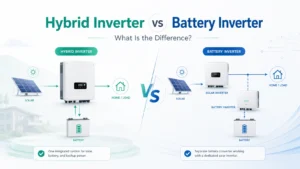
The most common objection in a retrofit conversation is some version of “will a new battery even work with the inverter I already have?” This is a legitimate question, and it’s worth having a clear, confident answer ready — because for AC-coupled retrofit battery systems, the answer is very often yes, with the existing solar inverter remaining in place and a separate battery inverter added to the AC side of the system.
If your retrofit proposals currently require a full system replacement by default, it’s worth reviewing whether an AC-coupled retrofit battery is a viable lower-cost alternative for your standard customer profile — it can substantially lower the entry price point for retrofit customers and make the 0% VAT saving proportionally larger relative to total spend.

Stocking and Sizing Strategy: The Inverter-to-Battery Ratio
For distributors and installers managing stock decisions, the policy landscape has a direct implication for what capacity ranges are likely to see demand growth — and a simple sizing heuristic helps translate that into inverter stocking decisions.
What Warm Homes Local Grant standardises — and what it doesn’t
The Warm Homes Local Grant’s standard package is 4kW solar plus 5kWh battery storage. This is likely to become a high-volume reference configuration for grant-eligible installs, simply because it’s the configuration that fits cleanly within the £12,000 cap for most installations.
But 5kWh is a conservative capacity for a household that wants to maximise self-consumption, particularly for customers who are also charging an EV or running heat pumps. For non-grant customers — and for grant-eligible customers who choose to top up the grant with their own contribution for a larger system — demand in the 10-16kWh range is likely to represent better margins and a better fit for the “energy independence” positioning that resonates with non-grant-eligible, higher-income customers.
The practical stocking implication: if your current SKU mix is weighted toward 5kWh units because that’s what’s been moving, it’s worth reviewing whether that reflects genuine customer preference or simply reflects what’s been quoted to date in a market where grant-funded 5kWh packages have been the most actively marketed configuration. As awareness of the retrofit opportunity and the broader 10-16kWh value proposition grows, demand mix may shift.
The sizing rule of thumb: inverter power ≈ half of battery capacity
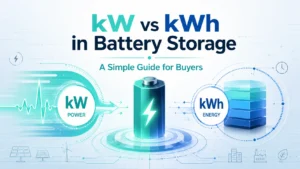
For pairing inverters with battery capacity across your product range, a useful working rule is that inverter power output in kW should be approximately half the battery capacity in kWh. This isn’t a hard engineering constraint — it’s a practical heuristic based on typical UK household discharge profiles, where batteries are generally sized for roughly a two-hour full discharge window under normal household load patterns.
This ratio is useful for two purposes. For quoting and bundling, it gives your sales team a fast default pairing without needing to refer back to detailed spec sheets for every quote — see a customer’s chosen battery capacity, halve it, and that’s your starting point for inverter selection. For stock planning, it lets you forecast inverter demand from battery capacity sales mix, since the two product categories should move roughly in this proportion across your portfolio.
Reference pairings using this ratio:
| Battery capacity | Inverter power (rule of thumb) |
|---|---|
| 5 kWh | 2.5–3 kW |
| 10 kWh | 5 kW |
| 16 kWh | 7–8 kW |
| 20 kWh | 10 kW |
Where the rule doesn’t apply: households with unusually high simultaneous load — electric showers, induction cooking, and a tumble dryer running at once, for example — may need an inverter sized closer to their peak instantaneous demand rather than the capacity-based ratio. For your sales team, a useful filter is simply asking whether the customer has multiple high-draw appliances they routinely run simultaneously; if yes, flag the quote for a peak-demand calculation rather than defaulting to the ratio.
Bundling battery and inverter as a single SKU simplifies grant-funded quoting
For grant-funded installs in particular, where the total package needs to fit within a fixed budget cap, pre-bundled battery-and-inverter packages at the ratio above reduce the number of variables in a quote and make it easier to demonstrate to a grant administrator that the specified system meets the programme’s technical requirements. If your current catalogue sells batteries and inverters as fully separate line items, consider whether a small number of pre-validated bundles — particularly at the 5kWh/2.5-3kW point that aligns with the Warm Homes Local Grant standard package — would reduce quoting friction for your installer customers.
Real Quote Comparisons: Grant-Eligible vs Standard Customer
These two scenarios illustrate the gap between a Warm Homes Local Grant-eligible customer and a standard customer — useful as a template for your own proposal documents, and as a illustration of why the eligibility screening conversation matters so much.
Scenario A: standard customer, 0% VAT only
A household with average UK consumption (roughly 3,300 kWh/year, at 26.11p/kWh — an annual electricity spend of approximately £862) installs a 10kWh battery with a 5kW inverter. At a typical installed price for this configuration, the 0% VAT relief saves the customer roughly £1,000-1,200 compared to the post-March-2027 5% rate on a system in this price range. Combined with SEG income and improved self-consumption, annual savings in the region of £300-450 are realistic, giving a payback period in the 12-15 year range on the battery component alone — a number that should be presented honestly rather than oversold, with the parallel benefits of price volatility protection and backup power capability framed as additional value beyond the simple payback calculation.
Scenario B: Warm Homes Local Grant-eligible customer
A household with income at or below £36,000 qualifies for up to £12,000 toward a 4kW solar + 5kWh battery system — potentially covering the full cost of the standard package. Customer-facing cost: £0, or a small contribution if they choose to upgrade beyond the standard package specification. From the customer’s perspective, this is an immediate, first-year positive return with no payback period calculation required at all.
The sales implication: these two scenarios produce dramatically different conversations, and the only thing that determines which conversation you’re having is a thirty-second eligibility check at the start of the call. Any sales process that doesn’t screen for this early risks either under-selling to an eligible customer (quoting them a price when they could get the system for free) or over-promising to an ineligible customer who assumed “the grants I read about” applied to them.
Compliance and Paperwork for Grant-Funded Installs
Grant-funded installations carry administrative obligations that standard cash-pay installs don’t, and getting this wrong creates risk for both installers and the distributors supplying them.
Specification compliance is checked, and retroactive fixes are expensive
Grant programmes typically specify minimum technical requirements for eligible equipment — commonly including minimum battery warranty length, minimum cycle life ratings, and certification standards. The risk for installers is straightforward: if a grant-funded installation uses equipment that doesn’t meet the programme’s specification, the grant claim can be rejected after the installation is complete, leaving the installer either absorbing the cost or attempting an expensive equipment swap.
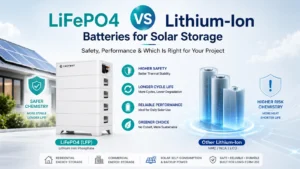
For distributors, this means your installer customers will increasingly ask for documentation confirming that specific battery models meet current grant scheme requirements — warranty terms, cycle life certifications, and relevant standards compliance (such as IEC 62619 for lithium battery safety). Having this documentation readily available, rather than requiring installers to chase it down separately for each grant application, is a meaningful service differentiator as grant-funded volume grows.
MCS certification remains the gateway for most schemes
Most UK grant and incentive programmes require installation by an MCS (Microgeneration Certification Scheme) certified installer, and often require the equipment itself to be on the MCS product database. If you’re an installer not currently MCS-certified, the cost-benefit calculation has likely shifted given the volume of grant-eligible work becoming available — and if you’re a distributor, confirming that your product range is MCS-listed (and keeping that listing current as product lines evolve) directly affects which of your installer customers can specify your products for grant-funded work.
A practical pre-installation checklist for grant-funded jobs
Before committing to a grant-funded installation, confirm: the customer’s eligibility has been verified through the correct channel (local authority for Warm Homes Local Grant, energy supplier for ECO4) rather than assumed from a self-reported income figure; the specified equipment — battery, inverter, and panels if applicable — meets the current technical requirements for the specific grant programme, which can change between funding rounds; the installation will be completed by an MCS-certified installer if required by the programme; and the paperwork trail (invoices, certificates, compliance documentation) is assembled before installation begins, not retrofitted afterward when a detail is found to be missing.
Can a customer use the Warm Homes Local Grant to top up a larger system than the standard 4kW/5kWh package?
The grant covers up to £12,000, which is calibrated to fully fund the standard 4kW solar + 5kWh battery package for most installations. If a customer wants a larger system, the grant can typically still be applied toward the cost, with the customer covering the difference — but this should be confirmed with the local authority administering the grant in each case, as implementation details can vary by region.
Does the inverter-to-battery sizing ratio apply to commercial or larger installations?
The roughly 1:2 ratio (inverter kW to battery kWh) is calibrated to typical domestic household discharge patterns. For commercial or larger residential installations with different load profiles — particularly sites with high continuous loads or specific peak-shaving requirements — a load-based sizing calculation is more appropriate than the simple ratio, which should be treated as a domestic-scale starting heuristic rather than a general engineering rule.
Conclusion
The 2026-2027 window combines four things that don’t often align: a hard VAT deadline that creates genuine urgency, a high-value grant programme that can fully fund installations for a meaningful share of UK households, rising electricity prices that improve the economics for everyone else, and a new-build mandate that’s reshaping customer expectations across the market.
For your business, the practical priorities are: build the eligibility screening question into the start of every sales conversation, not as an afterthought; revisit your existing solar-only customer base for the standalone battery retrofit opportunity; review your stocking mix against the 5kWh grant-standard package versus the 10-16kWh higher-margin segment; and get your grant-funded paperwork process tight before volume increases, rather than after.
If you’re a distributor reviewing your product range against current MCS listings and grant technical specifications, or an installer looking for pre-validated battery-and-inverter bundles at common sizing ratios, get in touch with our technical team — we maintain current compliance documentation for our battery range and can support bundle configuration for grant-funded proposals.
Get a Project-Based Lithium Battery Recommendation
Whether you are planning a home solar battery system, a high-voltage stackable battery solution, or a commercial energy storage project, EASYWAY can help you select a safer and scalable battery configuration.