The global energy landscape is undergoing a massive transformation. As grid volatility increases and renewable energy adoption accelerates, the question is no longer if we need energy storage, but what kind of storage provides the most reliable, profitable, and scalable solution.
For solar installers, EPCs (Engineering, Procurement, and Construction), and global distributors, the answer is clear: The future of energy storage lies in lithium solar batteries.
In this comprehensive industry analysis, we will break down the economics of solar battery costs, the massive shift in 2026 market trends, and why partnering with a reliable OEM/ODM manufacturer is the key to scaling your B2B energy business.
The Economics of Lithium Storage: Moving Beyond the Initial Price Tag
Historically, the upfront solar battery cost was the primary barrier to entry for both residential and commercial projects. However, industry professionals know that upfront cost does not equal total value. Modern lithium technologies—specifically Lithium Iron Phosphate (LiFePO4)—have radically altered the financial math.
Unbeatable ROI and Payback Period
For C&I (Commercial & Industrial) and residential customers alike, the focus has shifted to the payback period and long-term ROI. With a typical lead-acid battery, frequent replacements kill profitability. Lithium batteries offer an extended battery lifespan of 10 to 15+ years (up to 6,000–8,000 cycles). This longevity drastically reduces the Levelized Cost of Storage (LCOS), shortening payback periods to as little as 4–6 years in regions with high utility rates or peak-shaving demands.
The Gold Standard: LiFePO4 Safety
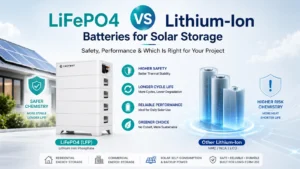
For installers and distributors, liability is a major concern. LiFePO4 safety is vastly superior to older NMC (Nickel Manganese Cobalt) chemistries. LiFePO4 batteries are highly resistant to thermal runaway, operate safely in extreme temperatures, and contain no toxic heavy metals. This makes them easier to permit, safer to install, and significantly more appealing to end-users.
Data Breakdown: The Numbers Don’t Lie
To understand why the market has completely pivoted to lithium, let’s look at the data.
Table 1: Lithium (LiFePO4) vs. Lead Acid Batteries
(Why EPCs are phasing out Lead Acid)
| Feature | Lithium (LiFePO4) | Deep Cycle Lead Acid | B2B Impact (Installers & EPCs) |
|---|---|---|---|
| Battery Lifespan | 10–15 Years (6,000+ cycles) | 3–5 Years (500-1,000 cycles) | Lower truck rolls and replacement warranties. |
| Depth of Discharge (DoD) | 90% – 100% | 50% | More usable energy per kWh installed. |
| Weight & Footprint | Lightweight, compact | Heavy, bulky | Faster, cheaper installation labor. |
| Maintenance | Zero maintenance | Requires water/ventilation | Zero ongoing maintenance contracts required. |
| LiFePO4 Safety | Exceptionally high (No thermal runaway) | High (but risks off-gassing) | Easier permitting, better customer peace of mind. |
Table 2: Residential vs. C&I Energy Storage
(Understanding your target deployments)
| Specification | Residential Storage | Commercial & Industrial (C&I) Storage |
|---|---|---|
| Typical Capacity | 5kWh – 20kWh | 50kWh – 2MWh+ |
| Voltage | Low Voltage (48V) or High Voltage | High Voltage (often 700V+) |
| Primary Use Case | Solar self-consumption, backup power | Peak shaving, demand response, grid arbitrage |
| System Architecture | Often all-in-one or stackable modules | Containerized systems, modular rack mounts |
2026 Market Trends: What Installers and Distributors Need to Know
As an energy storage industry analyst, looking ahead to 2026 reveals three massive trends that will dictate B2B profitability:
1. Continued Price Decline
Advancements in raw material extraction and massive scaling in global manufacturing are driving down the core solar battery cost. By 2026, we expect lithium battery pack prices to stabilize at historic lows, allowing EPCs to increase their profit margins while offering more competitive bids to end-users.
2. Aggressive Policy Support
Government incentives are turbocharging the market. From the ITC (Investment Tax Credit) in the US via the IRA, to REPowerEU in Europe, capital is flowing into battery storage. By 2026, strict mandates for solar-plus-storage in new commercial builds will make lithium batteries a non-negotiable building standard.
3. AI + Energy Storage Integration
The batteries of 2026 will not just store power; they will think. We are seeing a massive integration of AI with smart Battery Management Systems (BMS). AI will optimize charge/discharge cycles based on weather forecasts and real-time utility rates, further maximizing ROI. It also enables Virtual Power Plants (VPPs), allowing distributors to sell “smart-grid ready” hardware.
Objection-Handling: Why Some People Think Batteries are NOT Worth It (And Why They’re Wrong)
When selling to end-users or securing project financing, B2B buyers often encounter pushback. Here is how to handle the most common objections:
Objection 1: “The upfront solar battery cost is too high.”
The Reality: Buyers who say this are ignoring the Total Cost of Ownership (TCO). While the initial CapEx is higher than having no battery, the integration of lithium storage allows for peak-shaving, avoiding peak utility demand charges. When factored over a 10-year battery lifespan, the ROI is overwhelmingly positive.
Objection 2: “Lithium batteries are a fire hazard.”
The Reality: This is an outdated myth based on early NMC chemistries found in consumer electronics. Today’s stationary energy storage utilizes LiFePO4 safety standards. These cells physically cannot catch fire the way older lithium batteries did, even if punctured.
Objection 3: “The grid is reliable enough; we don’t need backup.”
The Reality: Extreme weather events and aging grid infrastructure are causing record numbers of blackouts globally. Furthermore, utilities are changing their net-metering policies (like NEM 3.0 in California), meaning exporting solar to the grid is no longer profitable. Storing it in a lithium battery is the only way to retain the value of generated solar power.
Scale Your Business with Eway Energy
To capitalize on the exploding energy storage market, installers, EPCs, and distributors need more than just a vendor—they need a strategic manufacturing partner.
Eway Energy is a premier OEM/ODM manufacturer and global supplier of advanced lithium battery solutions.
- Global Supply Chain Stability: We ensure you have the inventory you need, when you need it, avoiding project delays.
- Custom OEM/ODM Capabilities: Need white-labeled solutions or custom BESS (Battery Energy Storage System) specs for a massive C&I project? Our engineering team brings your vision to life.
- Uncompromising Quality: Built with premium A-grade cells, our batteries guarantee superior battery lifespan and ultimate LiFePO4 safety.
- A Reliable Partnership: We don’t just sell batteries; we provide technical support, competitive wholesale pricing, and the certifications needed for global deployments.
Ready to dominate the energy storage market in 2025 and beyond?
[Contact Eway Energy Today to discuss OEM/ODM distribution and wholesale pricing.]
How long do solar batteries last in 2026?
Thanks to advancements in cell manufacturing, a premium LiFePO4 solar battery in 2026 is engineered to last between 10 to 15 years, typically offering 6,000 to 8,000 cycles at 80% Depth of Discharge (DoD) before noticeable capacity degradation occurs.
What is the average ROI and payback period for commercial energy storage?
While it varies by local utility rates, the average payback period for commercial lithium storage is currently 4 to 7 years. Because the battery lifespan far exceeds this, businesses enjoy a high ROI through peak demand shaving and energy arbitrage for a decade or more post-payback.
Why is LiFePO4 safety superior to other lithium chemistries?
LiFePO4 (Lithium Iron Phosphate) has a highly stable covalent chemical bond. This means it is significantly less prone to thermal runaway compared to NMC (Nickel Manganese Cobalt). It can withstand higher temperatures, short circuits, and physical damage without combusting, making it the safest choice for residential and C&I installations.
How does solar battery cost factor into an EPC’s project margins?
While hardware costs make up a large portion of a BESS project, the declining solar battery cost of lithium, combined with rapid plug-and-play installation designs (reducing labor hours), allows EPCs to maintain healthy profit margins while delivering highly competitive bids.